Planning 2 weeks in Peru and looking for the best Peru itinerary out there?! Welcome, you’ve come to the right place! Read on for everything you need to know – how to get around, where to stay, my favorite spots, and of course a crazy comprehensive 2 week Peru itinerary!
I had been wanting to visit Peru for as long as I could remember. I mean, there’s a reason Machu Picchu’s been designated a Wonder of the World! So when I was trying to figure out where to go for my annual summer trip and realized it was a great time of year to visit Peru, I figured, well, why not?!


I’d already been to Europe SO many times in the summer (I can’t seem to stay away from the Mediterranean – Greece, Turkey, Italy, and Croatia, I’m looking at you), so I was looking for somewhere new. It was only my second time in South America (I’d been to Colombia before but nowhere else!), so I was beyond excited for all the colorful cultures, cute animals (hello alpacas and llamas), and jaw-dropping views around every corner (I’m sure you’ve seen photos of Rainbow Mountain!).
Plus snow-capped Andes towering over emerald valleys. Ancient Incan terraces carved into mountainsides. Colorful colonial towns with cobblestone streets, vibrant markets, and women in traditional skirts leading fluffy alpacas. And you can’t forget about the ceviche, fresh tropical juices, and endless cups of coca tea, of course! Peru may be diverse beyond belief, but that’s exactly what makes it magical. And I loved every second of it (minus the thin air at 12,000 feet).


Yes, I know this is a 2-week Peru itinerary, but I actually spent almost a month in the country. I’m lucky to have summers off (I work in education), so decided why not try and see it all?! You can certainly do the same, but I know most people don’t have that amount of time. So, with that being said, I decided to condense this into what I consider the most perfect 2 weeks in Peru! If you have a few extra days, even better!
So let’s get to it. If ancient Incan ruins, breathtaking Andean peaks, fluffy alpacas, and plates of fresh ceviche are your thing, I can guarantee you’ll love Peru just as much as I did.
But first, a pre-travel guide to Peru to learn a bit about the country and what to expect when you’re there.
Peru Itinerary Info and Logistics
Where is Peru and How to Get There
Peru is a vast and wildly diverse country on the west coast of South America, bordered by Ecuador and Colombia to the north, Brazil to the east, Bolivia to the southeast, and Chile to the south, with the Pacific Ocean stretching along its entire western edge. It’s home to everything from the soaring Andes Mountains to the lush Amazon rainforest and the arid deserts of the coast. It even shares Lake Titicaca with Bolivia (which is included on this 2 week Peru itinerary, dontchu worry!).
Thanks to this incredible variety of landscapes, you can go from misty high-altitude cities to jungle-covered ruins to dramatic ocean cliffs all within a single trip. And that’s what makes this Peru itinerary so fascinating – you don’t have time to get bored of an area, haha!


Flying Internationally
Of course you’ve gotta get yourself there first!
Most travelers fly into Jorge Chávez International Airport (LIM) in Lima – the main international airport in Peru and the hub for pretty much all long-haul routes. From there, it’s super easy to connect to other destinations in the country, like Cusco, Arequipa, Juliaca (for Lake Titicaca), and even the Amazon Rainforest.
Coming from the US, there’s plenty of nonstop flights from major cities like Los Angeles, Miami, New York, and Atlanta on airlines such as LATAM, Delta, American, and JetBlue. Unfortunately there’s no nonstop flights from San Francisco, where I was coming from.
So, I flew from SFO to Atlanta, and then continued on to Lima – not the quickest routing, but it worked! On the way home, though, I lucked out with a much smoother trip: I flew directly into LAX, then took a short flight back up to SFO, which felt way more manageable and way less exhausting. I found fares for about $900 roundtrip, although I scored mine for free using points (big win!).
From Elsewhere in South America
Already in South America?! While flying is by far the fastest option, there’s a few alternative routes if you’re coming from neighboring countries:
- Bus from Ecuador, Colombia, or Bolivia: Several companies run long-distance international buses that connect major cities in Peru with neighboring countries. Routes can take 10-24+ hours depending on where you start (yes, long!), but it’s a scenic and budget-friendly option.
- Boat/river travel: If you’re already exploring the Amazon region, some travelers enter Peru via river routes from Brazil or Bolivia – a more adventurous, off-the-beaten-path option.
- Overland from Chile or Argentina: There’s overland buses and tours that cross the Andes into southern Peru (Arequipa or Puno). These trips take longer but offer incredible views of high-altitude deserts and mountains.
- Flying within South America: There’s nonstop flights to Peru from several major cities across South America, including Bogotá, Santiago, Buenos Aires, and La Paz. Airlines that operate these routes include LATAM, Avianca, Aerolíneas Argentinas, Sky Airline, JetSMART, and Boliviana de Aviación.


Getting Around Peru
Peru is a huge country (no understatement there!), and getting from place to place can take some planning – but don’t worry, there’s plenty of options whether you’re looking for speed, comfort, or adventure. Peru is a very well-connected (and highly-visited) country, you just gotta know how to do it!
I’m including how to get from spot to spot in my (super) comprehensive Peru itinerary down below. This is just a general overview so you get an idea of what’s available in the country.
By Plane
For long distances, flying is of course the fastest way to get around, and there’s quite a few airports in the country. Domestic flights connect Lima with popular destinations like Cusco, Arequipa, Puerto Maldonado (for the Amazon), and Juliaca (for Lake Titicaca). Airlines like LATAM, Sky Airline, and JetSMART offer multiple daily flights. Flights can save you hours (or even days) compared to buses, especially when crossing the Andes.
But just keep in mind the altitude – if you’re going from Lima to Cusco by plane, your body won’t have time to gently acclimate, so be sure to stay EXTRA hydrated and give yourself at least a day or two to relax and take it easy before doing any hiking or strenuous activities.
During my near month in Peru, I actually only took two flights – from Cusco to Puerto Maldonado, and then from Puerto Maldonado back to Lima.
By Bus
Buses are the most common way to travel overland in Peru, and they range from budget “chicken buses” to luxury coaches with reclining seats, onboard movies, and snacks. Companies like Cruz del Sur and Movil Tours are popular for long-distance routes, and is what I took for longer rides. I’d definitely choose one of these luxury coaches for sure. If you’re familiar with luxury coach buses in Mexico, they’re pretty similar!
I actually took a night bus from Nazca to Arequipa on Cruz del Sur, and while it wasn’t the most comfortable sleep I ever had, it wasn’t too terrible, haha. I wouldn’t wanna do it multiple nights in a row, but they’re a great option to save on accommodation and maximize sightseeing time.


By Car
Renting a car can be fun if you’re planning to explore off-the-beaten-path areas, especially along the coast or in the Sacred Valley. Just know that driving in the cities can be hectic, road signage is inconsistent in rural areas, and some mountain roads are challenging.
If this is your first time in Peru, I’d honestly skip the car rental and just use luxury coach buses and guided day tours – there’s really no reason for a car.
By Taxi or Rideshare
I used rideshares in Lima, Cusco, and Arequipa plenty of times, and had great experiences. I found prices to be more than reasonable (and way less than at home in San Francisco).
If you’re grabbing a taxi off the street, make sure you agree on the fare before getting in. That said, I personally preferred using rideshare apps since it takes away the guesswork – no negotiating, no price surprises, and it definitely helps avoid any language barrier confusion too.
By Train
Peru has some scenic train routes, especially if you’re headed to Machu Picchu. The Inca Rail and PeruRail trains travel between Cusco or Ollantaytambo and Aguas Calientes (Machu Picchu town). It’s more expensive than the bus but absolutely worth it for the views and convenience. For reference, I took the train between Cusco and Aguas Calientes, and it was marvelous! Those views, just wow!
When to Plan Your Peru Itinerary

Peru is a country of incredibly diverse climates, so the best time to visit depends on which regions you plan to explore. Like many destinations with both tropical and mountainous zones, Peru basically has two main seasons – the dry season and the wet season. Psst – for most travelers, the dry season is your best bet, wink wink.
Dry Season: The dry season, running from May through September, is the most popular time to visit the Andes and highlands. Days are typically sunny with clear skies, and temperatures are generally comfortable and not too hot – perfect for hiking, exploring Machu Picchu, or wandering through the Sacred Valley.
Coastal regions like Lima are cooler during winter months (June–August) and often overcast, but the lack of rain makes sightseeing easy. The Amazon and jungle areas are also drier, making wildlife excursions and boat trips way less muddy.
For reference, I visited Peru from mid-July to early August, and the weather was mostly perfect – sunny days in the mountains, cooler along the coast, and very little rain – ideal for exploring everything from Machu Picchu to Lake Titicaca to the Sacred Valley. It was definitely much cooler than I expected – pack some warm layers if you’re visiting this time!
Wet Season: First time in Peru? I’d avoid the wet season for sure. The wet season runs from November to March, with frequent afternoon showers in the Andes and rainforest. While this can make trekking a bit muddy or even cause temporary trail closures (NOT what you want on a bucket list trip), the rain brings lush greenery, fewer tourists, and lower prices on accommodations.
Coastal areas are generally mild but can be foggy or damp. Visiting during this season can be rewarding if you don’t mind a little unpredictability and want to enjoy quieter sites, especially in the mountains and jungle. BUT I’d avoid it. You actually wanna be able to see Machu Picchu, right?!

Peru’s climate also varies greatly by region:
- Coast (Lima, Paracas, Huachachina): Mild year-round, with cooler, overcast “winter” months from June – August. Northern beaches like Máncora are warmer and drier during this time.
- Andes (Cusco, Sacred Valley, Arequipa, Puno): Dry season May – September is ideal; wet season can be rainy and make trails muddy.
- Amazon & Jungle (Iquitos, Puerto Maldonado, Manu): Wet season November – March brings heavy rain; June – September is drier and more comfortable for wildlife excursions.
Note that peak tourist season is June – August, so book tickets, trains, and accommodations well in advance. Shoulder months like April – May or September often offer fewer crowds while still avoiding heavy rain. Peru also has amazing festivals to consider, such as Inti Raymi in Cusco (June 24) and Semana Santa (March/April), which are incredible to experience but are busy, busy busy, so definitely book hotels way in advance.
Health and Safety in Peru
Can I drink the water in Peru?
Always an important question! Short answer: nope. Tap water isn’t potable in most places, so stick to bottled water or filtered water whenever you can. Lots of hotels and restaurants automatically serve tap water unless you specifically ask otherwise, so double-check before chugging. And watch out for ice – it’s often made from tap water, so I usually skip it unless I know it’s safe.
I had no problems finding bottled or filtered water; they’re so inexpensive in little markets around town. Be sure to stay hydrated, especially while you’re acclimating to higher altitudes.
Vaccines and Medication
As for vaccines and meds, you don’t need anything wild, but there’s a few essentials depending on where you’re headed. If you’re going to the Amazon, most doctors recommend the Yellow Fever vaccine (which is good for life!) and sometimes malaria medication (I chose to take it – better be safe than sorry in my opinion).
For the Andes (Cusco, Sacred Valley, Lake Titicaca), you may wanna chat with your doctor about Diamox for altitude – it helped a bunch of people in my group including myself (be sure to read the directions carefully as you need to start taking it before reaching altitude). And of course, the usual travel vaccines like typhoid and Hep A/B are good to have.
I also highly recommend packing a little “just in case” kit with stomach meds. Peru’s food is incredible (genuinely some of the best you’ll ever eat) but a few people in my group still ended up feeling pretty rough for a day or two. Better to have it and not need it, you know?
Altitude & Acclimatization
This is SUCH an important topic, so keep reading!
Many of Peru’s top destinations (Cusco, Machu Picchu, Puno/Lake Titicaca, and the Sacred Valley) are at very high elevations, which can affect you in ways you might not expect. If you’re not used to high altitudes, you really have no clue how your body will react – altitude doesn’t discriminate and little factors contribute. You can be in tip top shape and perfectly healthy and still feel the negative effects of altitude.
Altitude sickness is a real thing and shouldn’t be underestimated. Symptoms can include headaches, nausea, dizziness, fatigue, and shortness of breath. Some people are more sensitive than others, so it’s always better to err on the side of caution.
Always aim to acclimate first. One of the smartest ways to avoid altitude sickness is to gradually increase your elevation rather than jumping straight into the highlands. I personally planned my route not only because it covered all the spots I wanted to see in Peru, but also because it made sense altitude-wise.
For example, flying directly from Lima (sea level) to Cusco (11,150 feet / 3,399 meters) is a major shock to your body, although tons of people still do it. Instead, I chose a route that allowed me to gently increase in altitude, giving my body time to adjust while still enjoying all the major destinations. I was super mindful when planning out my Peru itinerary because I was SO anxious about the high altitude and if it’d make me sick. I stressed about it for weeks, no joke. And almost didn’t book the trip because of that.
Here are some key altitude points in Peru for reference:
- Lima: 0–100 feet / 0–30 meters (sea level)
- Sacred Valley (Ollantaytambo, Pisac): ~9,000–9,350 feet / 2,750–2,850 meters
- Cusco: 11,150 feet / 3,399 meters
- Machu Picchu: 7,970 feet / 2,430 meters
- Puno/Lake Titicaca: 12,500 feet / 3,810 meters
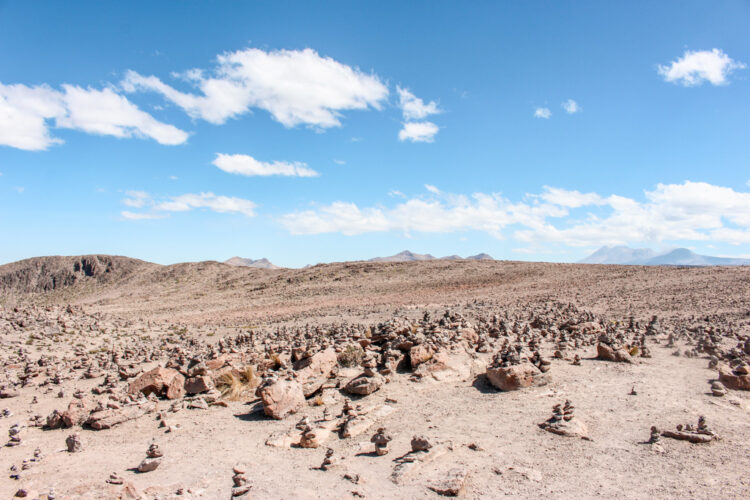
During our drive from Arequipa to Chivay, we actually stopped at a viewpoint at a whopping 16,000 feet high. Which is so insane! Our guide only let us stay here for about 20 minutes or so because the air was incredibly thin and the risk of getting sick increases the higher you go.
Tips to prevent or reduce altitude sickness:
- Take it slow on arrival: Don’t schedule strenuous hikes or activities on your first day at high altitude. Short walks, light sightseeing, and plenty of rest are ideal.
- Stay hydrated: Drink lots of water and avoid alcohol and heavy meals for the first 24-48 hours. I always forget to drink water (I just don’t get thirsty naturally!) so had to make sure I drank enough to keep my body hydrated (yes, even if it meant I always had to pee!).
- Consider altitude sickness medicine: Medications like acetazolamide (Diamox) can help prevent symptoms, but check with your doctor before use. My doctor prescribed Diamox for me before my trip and I followed the instructions to a T and got lucky with zero altitude issues! Phew!
- Coca leaves/tea: Traditional coca tea is widely available in Peru and can help alleviate mild symptoms. It’s part of the culture here so I’m sure you’ll have it at least a few times without even realizing, haha.
- Listen to your body: Don’t push yourself if you feel dizzy, nauseous, or unusually fatigued. Descend to a lower elevation if symptoms worsen. You don’t wanna end up in the hospital, which can in fact happen!
Is Two Weeks in Peru Enough?
Yes… but also no, haha. Peru isn’t massive compared to some other South American countries, but it’s incredibly diverse – think high-altitude Andean villages, the lush Amazon rainforest, ancient Inca sites, dramatic desert coastlines, and some of the best food on the planet. It’s literally impossible to see and do all that Peru has to offer no matter how much time you have.
You can see a whole lot in two weeks in Peru, especially if you plan smartly and don’t try to squeeze in every region. Just know it takes longer than you’d think to get between spots, so include a few travel days into your Peru itinerary (like I did below).
This Peru itinerary hits the big highlights: Lima’s food scene, Machu Picchu and the Sacred Valley, the floating islands of Lake Titicaca, and even a taste of the Amazon. But trust me, when you visit you’ll be adding even more spots in Peru for next time! It’s truly a remarkable country and I feel so grateful I was able to spend almost a month here.
Other Peru Itinerary FAQs
Currency in Peru
Peru is generally very affordable, especially compared to major US cities like San Francisco and New York City (and generally anywhere in the states, haha). Restaurants, transportation, activities, and even hotels tend to be far more budget-friendly than many places in North America or Europe. You’ll easily find hotels for $50-$80 a night!
Peru uses the Peruvian sol (PEN), and the exchange rate tends to be pretty favorable for US travelers. At the time of writing, the exchange rate is roughly 1 USD = 3.36 PEN (Peruvian soles). To get a rough estimate of PEN to USD, simply divide the price in soles by three (15PEN = ~$5USD, 30PEN = ~$10, etc). Seems a bit confusing at first but you’ll get the hang of it pretty quickly; I did! It slightly overestimates the USD cost, which is perfect because you’ll never undershoot what you’re spending.
Card vs. cash: I used my credit card at most restaurants, hotels, and larger shops throughout Peru. But you’ll absolutely want some cash on hand – especially in markets, small cafes, street food stalls, rural areas, and for tipping guides or drivers. Many smaller businesses are still cash-only, especially outside major cities like Lima and Cusco.
How to Get the Best Exchange Rate: Always take out cash from an ATM once you arrive in Peru – never at an exchange desk or before your trip in the US. ATMs consistently offer the best rate.
And if you want to avoid annoying ATM fees every time you withdraw, either go to Multi-Red ATMS in Peru or get a no-fee debit card like Charles Schwab (which has been my go-to for years; they reimburse all ATM fees worldwide). Just be sure to decline any “dynamic currency conversion” the machine offers – always choose to be charged in the local currency (soles), not US dollars (something I still need to remind my husband about!).
Language in Peru
Spanish is the official language of Peru, and it’s what you’ll hear most in cities, towns, restaurants, taxis, and basically anywhere you go as a traveler. English isn’t widely spoken once you’re outside major tourist hubs, so knowing a handful of basic Spanish phrases will make your trip so much smoother – especially when it comes to ordering food, asking for directions, or talking to drivers and market vendors.
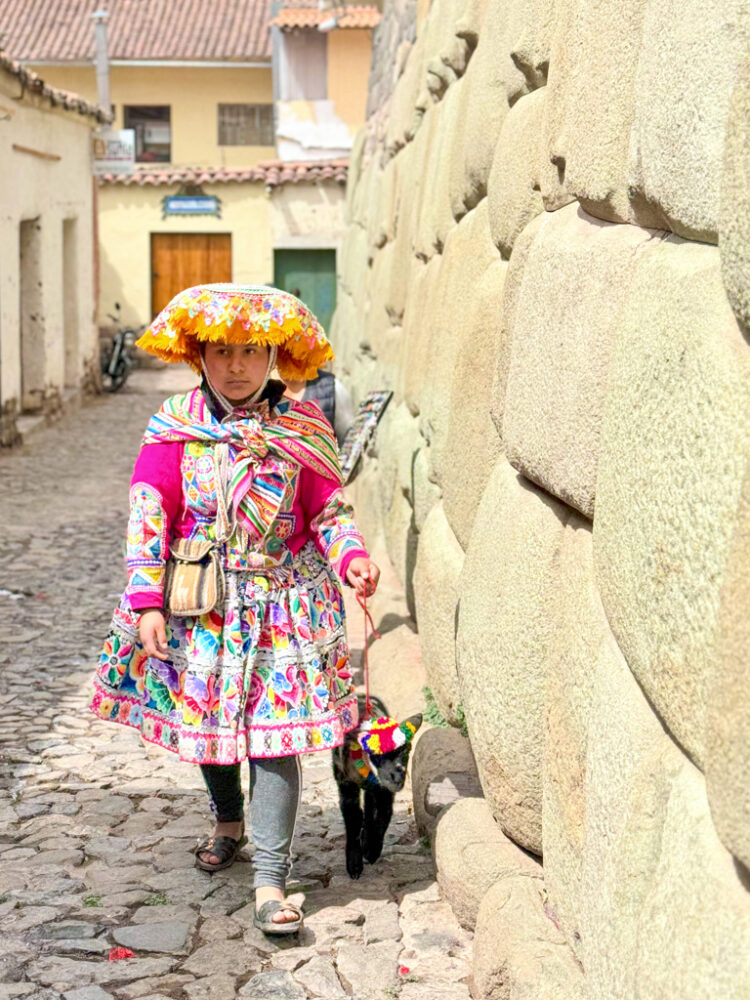
What makes Peru especially interesting, though, is its rich linguistic diversity. Alongside Spanish, you’ll also find Indigenous languages like Quechua and Aymara, which are still spoken in the Andes and highland regions. In places like Cusco or the Sacred Valley, don’t be surprised if you hear Quechua woven into everyday conversation. It’s a beautiful part of Peru’s cultural identity, and locals love it when visitors show even a tiny bit of appreciation or curiosity about it.
When I did a homestay on Lake Titicaca, my hosts spoke Quechua as their first language, so we ended up communicating in Spanish – which wasn’t the native language for any of us! It led to lots of slow sentences, hand gestures, and laughs, but we somehow got by. It was one of those travel moments that reminds you how much connection matters more than perfect vocabulary.
What to Eat in Peru
Peruvian food is next-level and honestly a legit reason to book a trip on its own. From the tangy freshness of ceviche to hearty dishes like lomo saltado, it’s safe to say I loved every meal I had, haha.

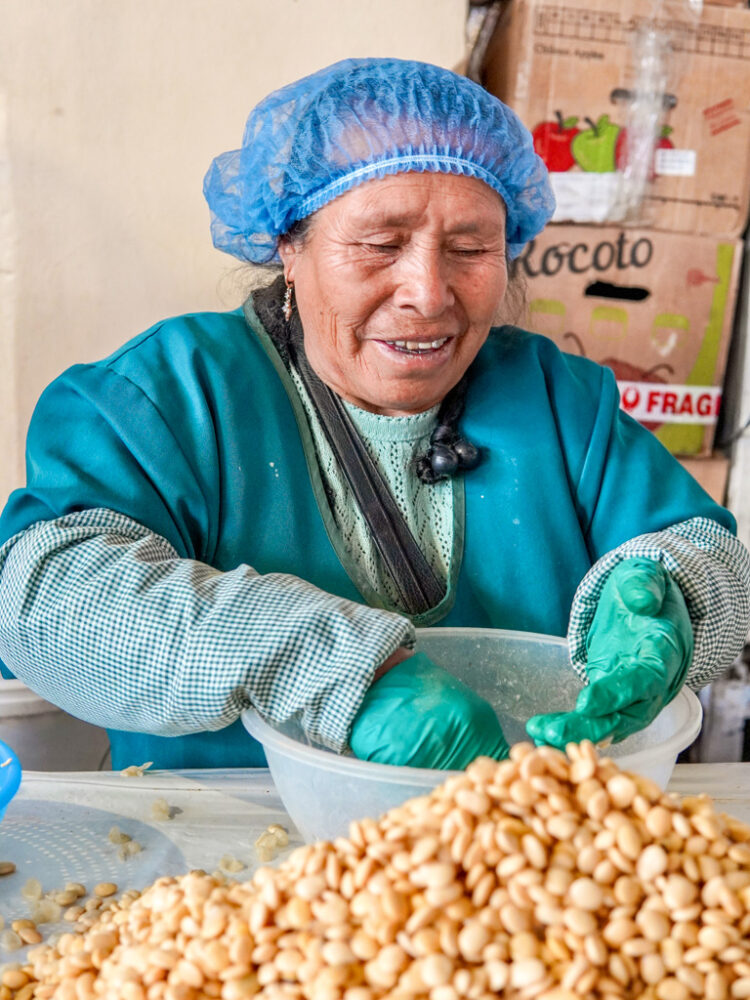
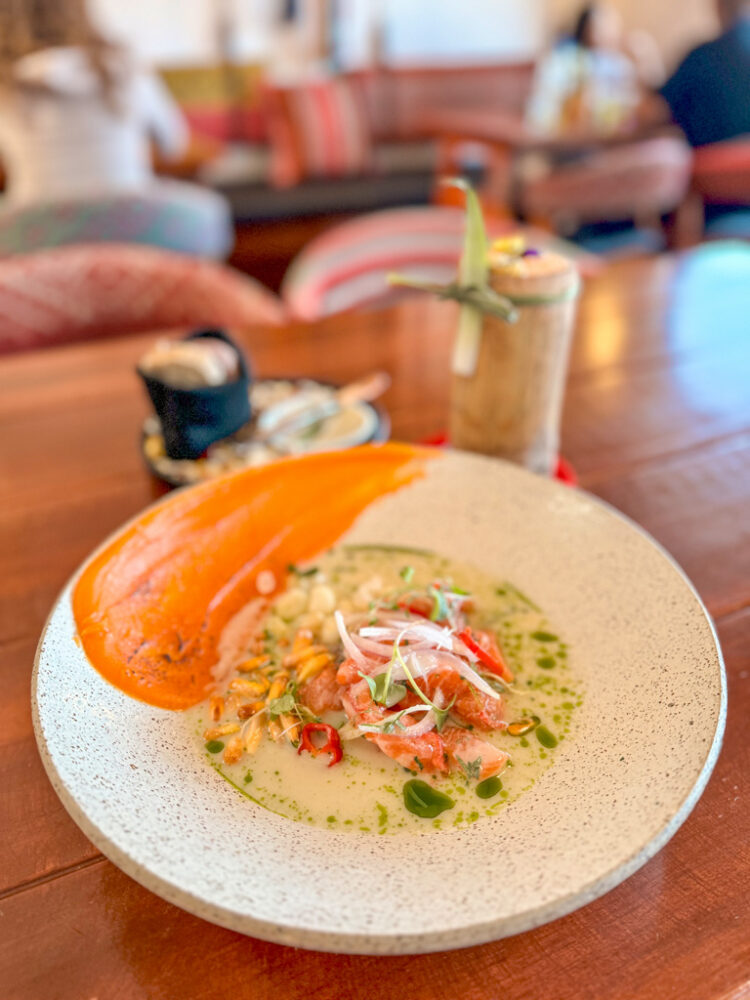
And there’s so much variety! Think street food, markets, and even high-end Michelin-star restaurants – I promise you won’t go hungry here! And don’t forget the drinks – I had too many sweet chicha moradas and of course iconic Pisco Sours! Here’s a few (okay, a whole bunch!) of things to try in the country!
- Classic ceviche: Raw fish “cooked” in lime juice with red onion, cilantro, and a spicy kick. My favorite!
- Papa a la huancaína: Sliced potatoes smothered in a creamy, mildly spicy yellow aji amarillo sauce.
- Ají de gallina: Shredded chicken in a rich, silky yellow pepper sauce with a hint of nuttiness.
- Pollo a la brasa: Peruvian-style rotisserie chicken, crispy on the outside, juicy on the inside, often served with fries and aji sauces.
- Lomo saltado: Wok-fried beef tossed with onions, tomatoes, and fries – Peru’s ultimate comfort dish.
- Cuy (guinea pig): A traditional Andean delicacy, often roasted whole with crispy skin.
- Alpaca: Lean, tender meat similar to beef but lighter and often served grilled.
- Chicha morada: Sweet, purple corn drink flavored with cinnamon and cloves.
- Chifa: Peruvian-Chinese fusion cuisine, think fried rice, stir-fried noodles, and savory dishes with a local twist.
- Pisco Sour: Peru’s signature cocktail made with pisco, lime, simple syrup, and frothy egg white.
- Choclo: Big, starchy Peruvian corn kernels, often boiled and served as a side or in salads, soups, and anticuchos. I LOVED these!
- Lucuma: A naturally sweet, custard-like fruit often found in smoothies, ice cream, or desserts.
- Inca Kola: Sweet, bright yellow soda, a quirky but iconic Peruvian soft drink.
- Picarones: Sweet pumpkin and sweet potato doughnuts, fried and drizzled with syrup. YUM!
The Perfect 2 Week Peru Itinerary
Phew, now that we got all those logistics and info outta the way, here’s how I’d spend 2 weeks in Peru!
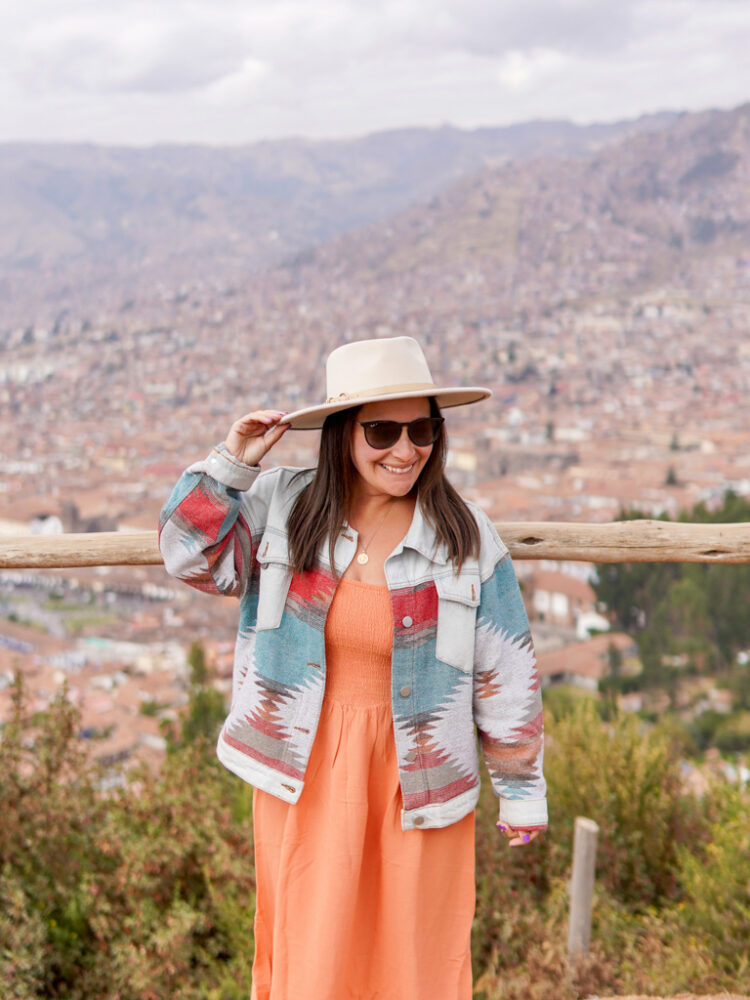
A few notes about this 2 week Peru itinerary:
- This itinerary assumes you have a full 14 days on the ground. If you arrive late at night, plan to officially start the next morning.
- If you want to hike the Inca Trail or visit both the Amazon and Lake Titicaca, you’ll need more than two weeks (there’s just so much to see in Peru!). Otherwise, you can skip Days 2–5 and fly straight to Puno or Cusco, depending on whether Lake Titicaca or the Amazon is your priority (the Amazon fits more naturally as a later add-on).
- This route focuses on southern Peru (home to Lima, Cusco, and Machu Picchu). If multi-day treks are calling your name, consider heading north to Huaraz instead.
- The itinerary moves through Peru’s major regions – coast → desert → Andes → highlands → rainforest – in a logical clockwise loop. The only slightly chaotic part is the Paracas/Huacachina → Arequipa night bus → Puno/Cusco timing, but honestly… that’s the Peru experience. Transport can be long, bumpy, and weirdly indirect. Just go with it.
- It’s busy, busy, busy. Efficient, yes – relaxing, absolutely not. To explore everything at a more comfortable pace, add 3 – 4 extra days split between Lima and Cusco.
- Since you’ll be changing hotels almost every night, pack thoughtfully and stay organized. Keeping my suitcase sorted with packing cubes made a huge difference!
- This itinerary starts and ends in Lima. If you wanna head to the Amazon at the end of the trip, you can fly direct from Cusco to Puerto Maldonado (no reason to head to Lima first).
Peru Itinerary At-A-Glance
- Day 1: Lima
- Day 2: Paracas and Huacachina
- Day 3: Arequipa
- Day 4-5: Chivay and Colca Canyon
- Days 6-7: Puno and Lake Titicaca
- Day 8-13: Cusco, Sacred Valley, Machu Picchu
- Day 14: Lima
- Day 15+: Puerto Maldonado (Amazon)
Day 1: Lima
Welcome to Peru! Most international flights land in Lima, so you’ll likely kick off your trip here (which is exactly what I did).
Lima sits right on the Pacific coast and is famous for two things: food and fog (hello, misty gray skies). It’s not the prettiest city at first glance, but once you settle into Miraflores or Barranco, it starts to charm you with cliffside views, leafy parks, and ridiculously good restaurants.
And at sea level, Lima is the perfect place to ease into your trip before you start climbing into the high-altitude parts of the country.
If you’re cramming multiple destinations into this 2 week Peru itinerary, you’ll have limited time in Lima (on purpose). Plan out your day and you can still see oh so much! Here’s a few things to pick and choose from for your one day in Lima:
- Walk the malecon, Lima’s famous cliffside walkway. It stretches for miles and gives you gorgeous views over the Pacific – expect joggers, surfers, and paragliders cruising through the sky. It’s unfortunately notoriously gloomy (especially in winter months), but still worth a visit regardless! Stop by Parque del Amor (Love Park) to see the mosaics and huge kissing sculpture.
- Wander Miraflores – full of leafy streets, bakeries, and restaurants. Have breakfast at Liberta Cafe, see the adorable resident cats at Kennedy Park, do some shopping (I bought a gorgeous alpaca scarf at KUNA Larco and some cute souvenirs from Mercado Artesanal), take a chocolate-making class (!!!), and grab a bite at La Lucha Sangucheria Criolla (the pork sandwiches are so juicy and flavorful).
- Enjoy some ceviche for lunch (many options but Punto Azul, La Mar Cevicheria, and El Mercado are popular). Or take a cooking class and learn how to make your own (plus pisco sours of course!).
- Head over to Barranco, an artsy district full of street art (so many colorful murals!), indie boutiques, fun bars and restaurants (like Ayahuasca!), the famous Bridge of Sighs (Puente de los Suspiros), and Bahada de Banos.
- Take a city tour and check out Centro Historico (downtown Lima), and stop by the main square, Lima Cathedral, the Government Palace of Peru, and the House of Peruvian Literature.
- If you’re feeling fancy, check out one of the world’s best restaurants, yes, right here in Lima! There’s Maido, Central Restaurante, and Astrid y Gastón, and yes, they’re popular for a reason so make a reservation well in advance!
- Still have some energy? Uber up to Circuito Mágico del Agua (Magic Water Circuit of the Reserve Park). You’ll need a ticket to get in (which you buy at the door), but inside there’s an evening laser light show against all the fountains. We loved wandering around and sharing some Peruvian picarones of course!
You can even swim with sea lions and paraglide over the city – two experiences still on my Peru bucket list (told ya there’s tons to do here!).
One thing to keep in mind: Lima traffic is chaotic, so it’s best to stick to the coastal neighborhoods on your first day unless you’re feeling brave. And about the weather – if you get sunshine, consider it a blessing. The city loves its dramatic cloud cover, which is unfortunately what I got when I visited. But honestly, once you’re sipping a Pisco Sour overlooking the ocean, the fog kinda adds to the vibe.
Where to Stay in Lima
Lima is known for not being the safest city in the world, so I recommend sticking to Lima’s tourist-friendly neighborhoods of Miraflores or Barranco (read: safe and moderately upscale).
I’d choose to stay in Miraflores for pure convenience since there’s tons of cafes, shopping, outdoor parks, and even panoramic ocean views nearby.
I personally stayed in a private room at Selina Miraflores Lima and it was perfect for 2 nights (the night I arrived plus after my full day in Lima).
Day 2: Paracas and Huacachina, then night bus to Arequipa
Paracas
Kick off your second day with an early drive or guided tour down the coast to Paracas, a sleepy seaside town that serves as the gateway to Peru’s “mini Galápagos.”
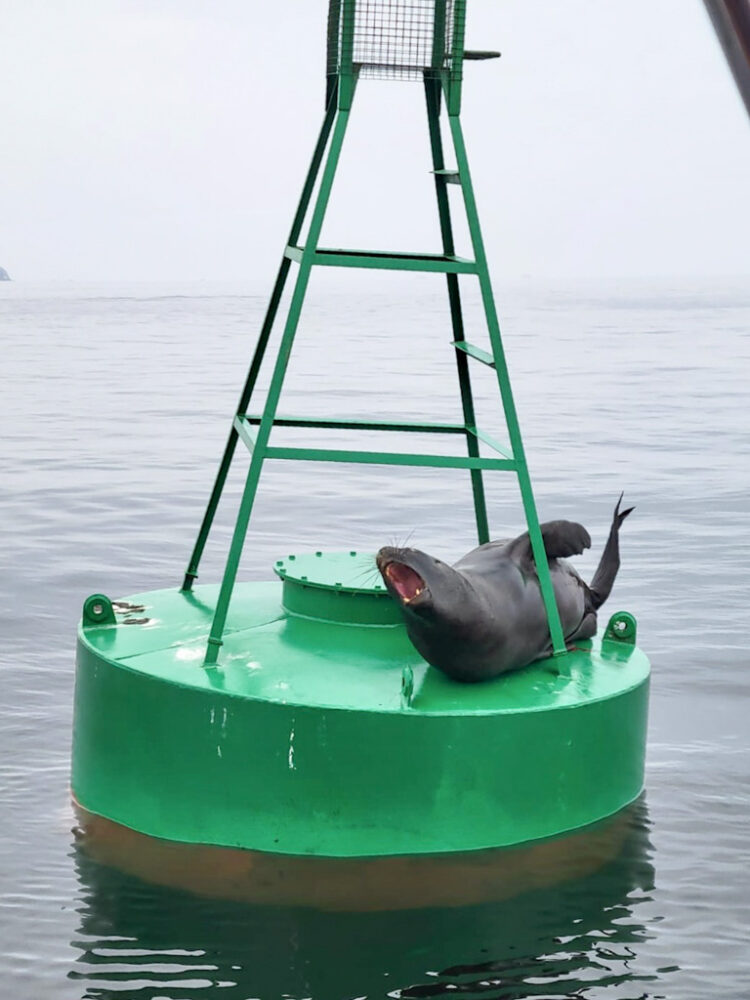
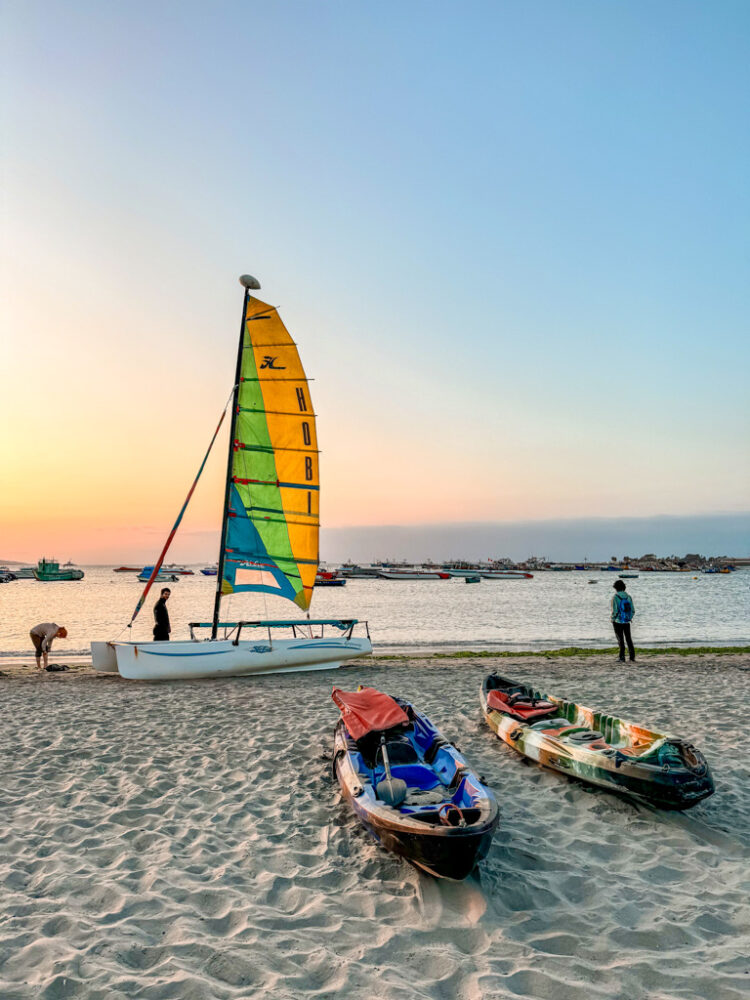
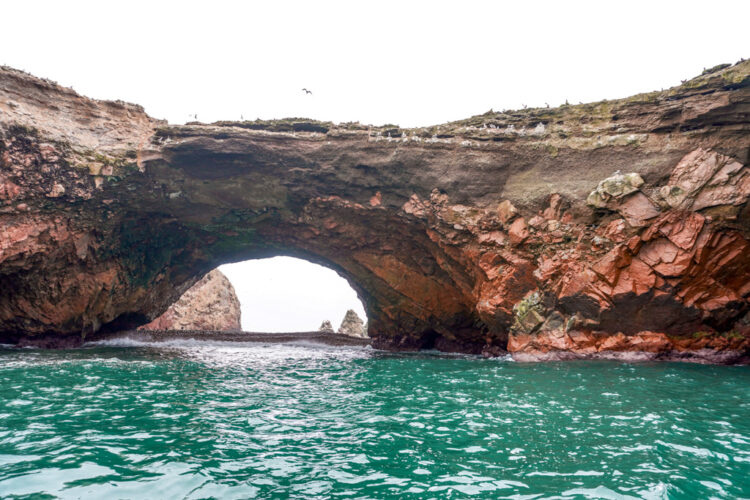
The star attraction is the Islas Ballestas, where you’ll hop on a speedboat and cruise past rock arches, massive bird colonies, sea lions, and – if you’re lucky – Humboldt penguins (we saw some from afar!).
It’s an easy, low-elevation day (basically sea level), so it’s a great way to enjoy nature before you head into the Andes later in the trip. After your boat tour, grab a coastal lunch like jalea (mixed seafood) or a classic ceviche, which is especially good this close to the ocean.
Huacachina
Nearly every tour includes both Paracas and Huacachina, which is perfect because I highly recommend visiting both! From Paracas, you’ll continue inland to the desert oasis of Huacachina, one of the most surreal landscapes in Peru. This was one of the destinations I was most excited about, and boy was it oh so much fun.
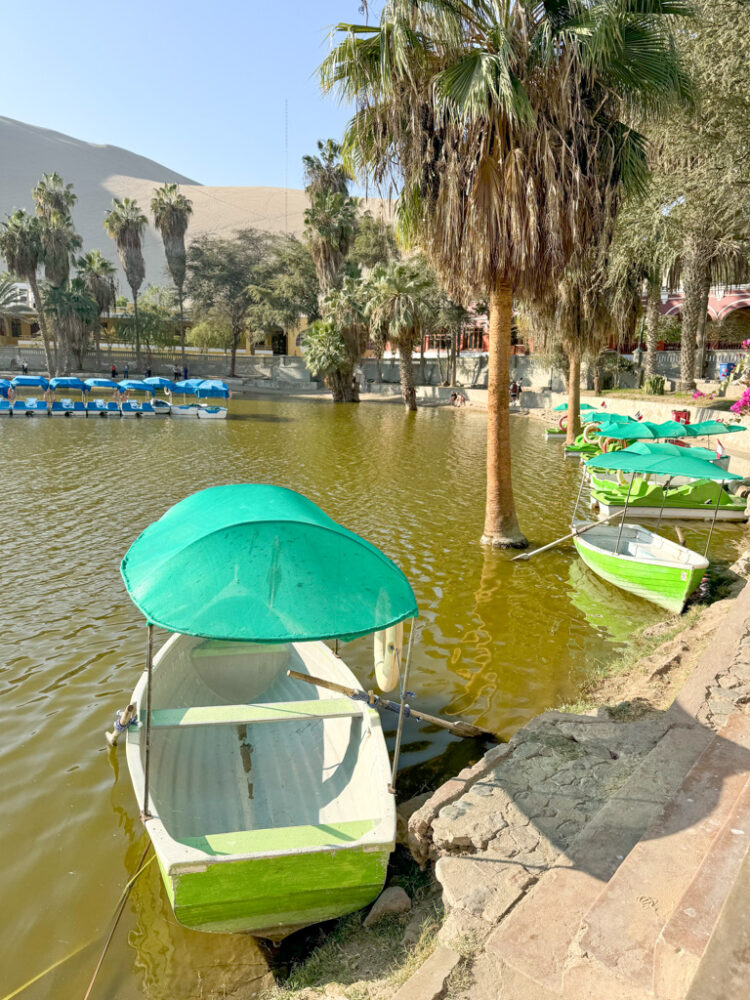
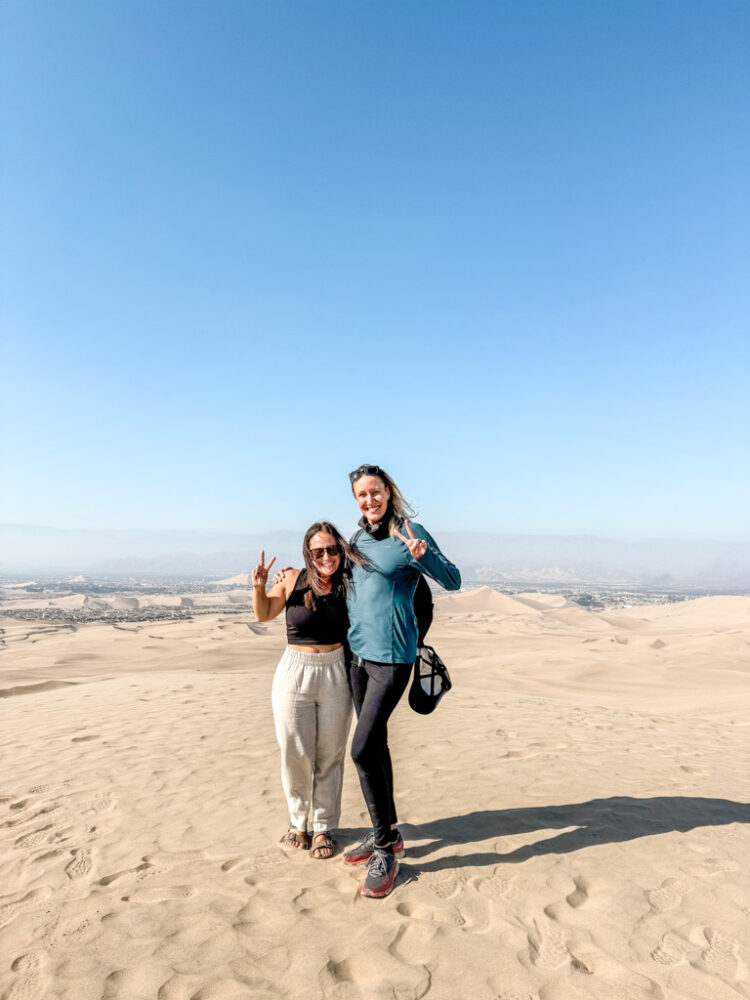
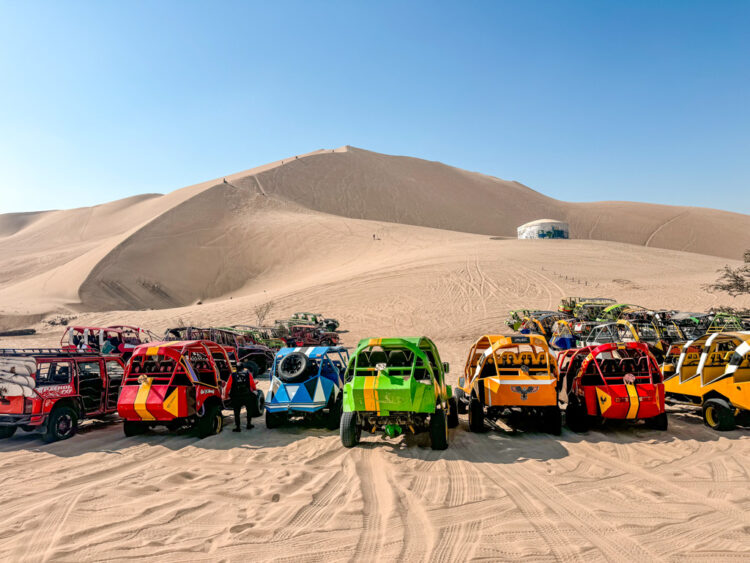
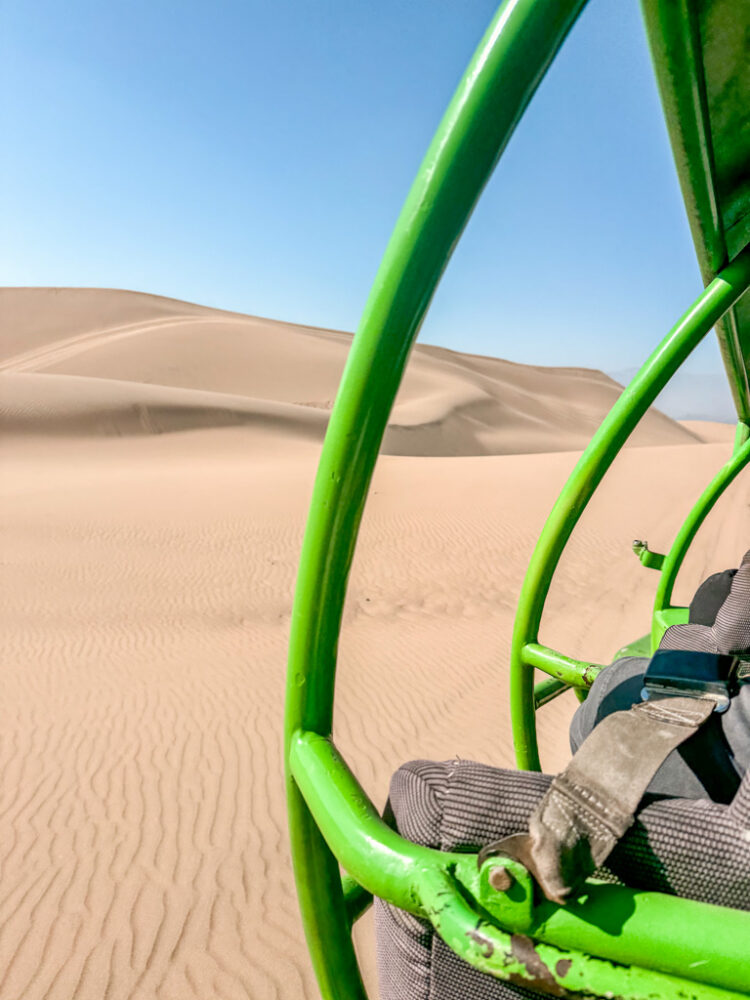
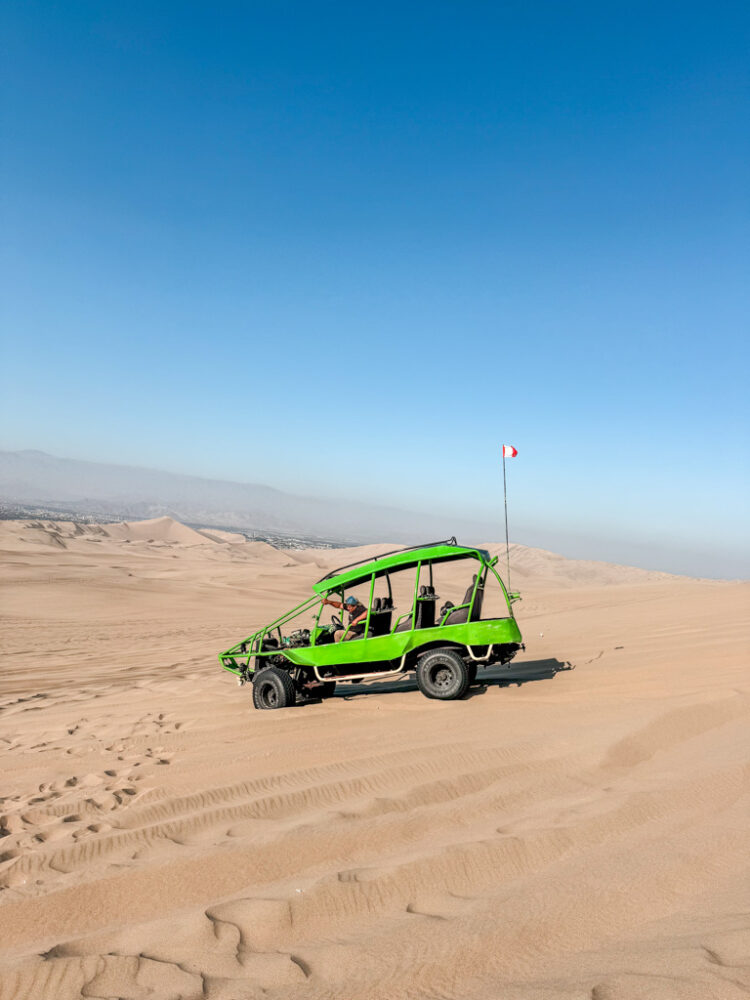
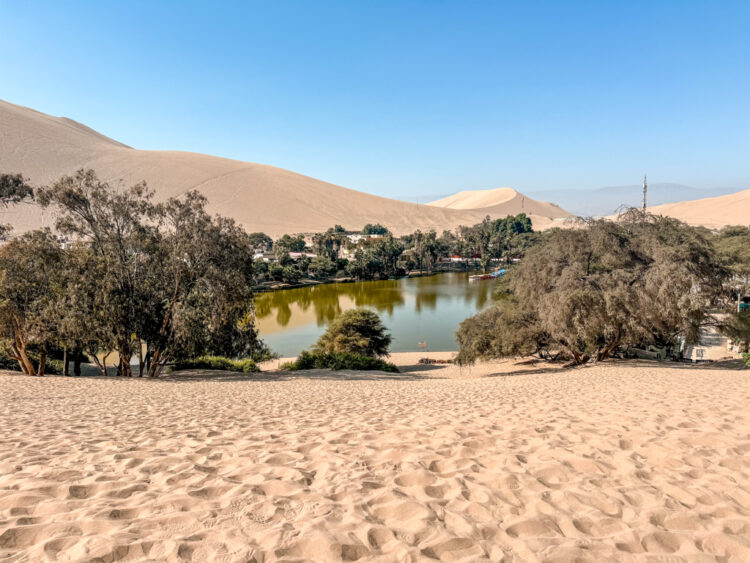
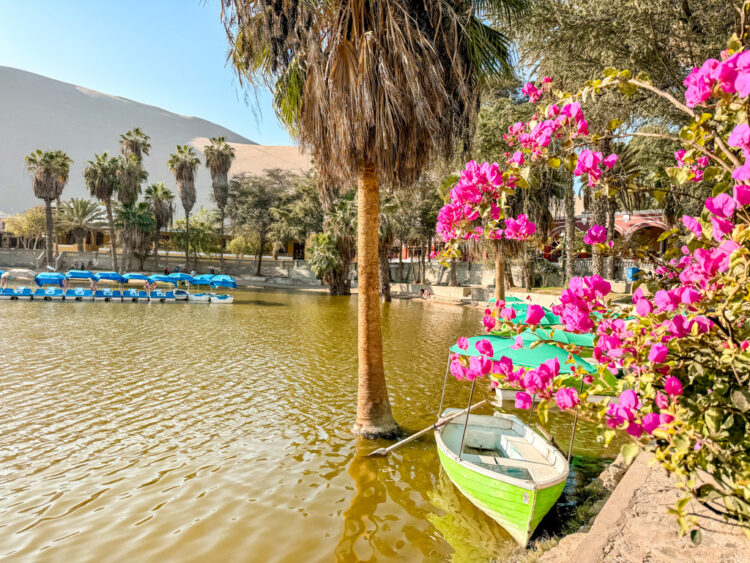
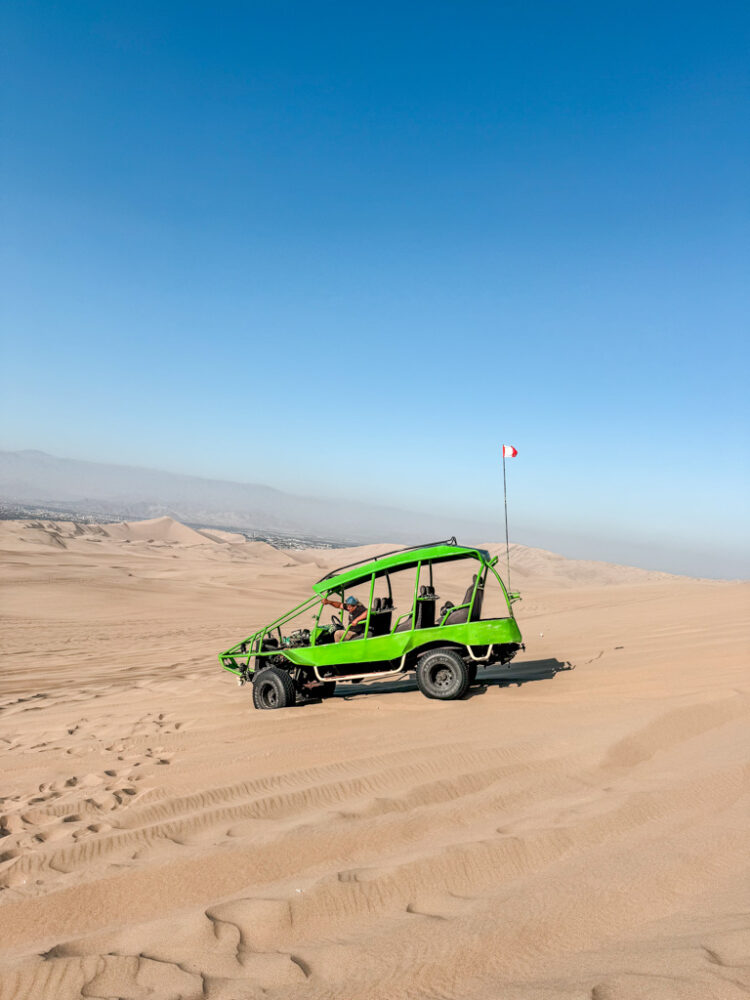
What I found was a palm-fringed lagoon tucked between jaw-dropping sand dunes that looked straight out of a movie set. And the main reason I wanted to come here?! Sandboarding down those massive golden dunes and thrilling dune buggy rides. My group laughed so incredibly hard – I swear it was like a nonstop rollercoaster that I wished never ended!
You literally need to hold on tight – the drivers aren’t scared at all, haha. And boarding down the sand is ridiculously fun even if you’ve never touched a snowboard. I just recommend sitting down on the board and definitely not attempting to stand up if you’re clumsy like me. Huacachina is tiny, touristy, and low elevation, but the desert views at sunset are incredible.
If you’ve got time (or if you’re staying overnight), stop at a pisco vineyard in nearby Ica to learn how Peru’s national spirit is made – plus you can taste-test your way through different varieties. My favorites were the coffee pisco and the lucuma pisco – so yummy!
Optional: Nazca Lines
Psst: If you wanna fly over the Nazca Lines (another bucket list check in Peru), add an extra day in this area and overnight in Nazca instead. It’s nearly impossible to squeeze a flight into the same day as Paracas and Huacachina.
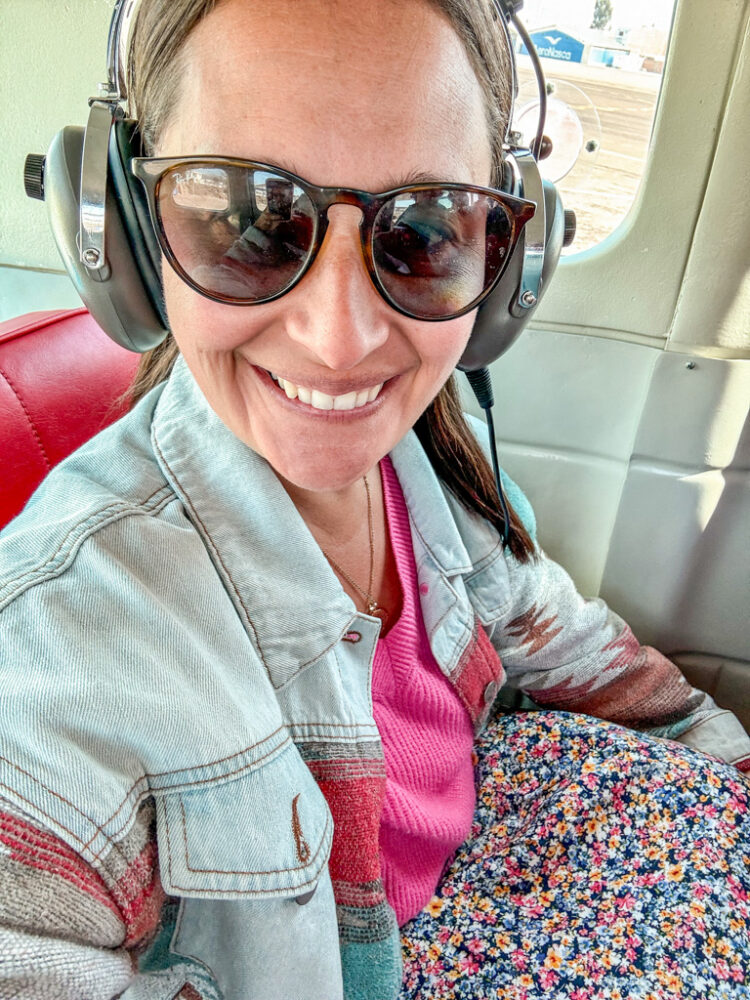
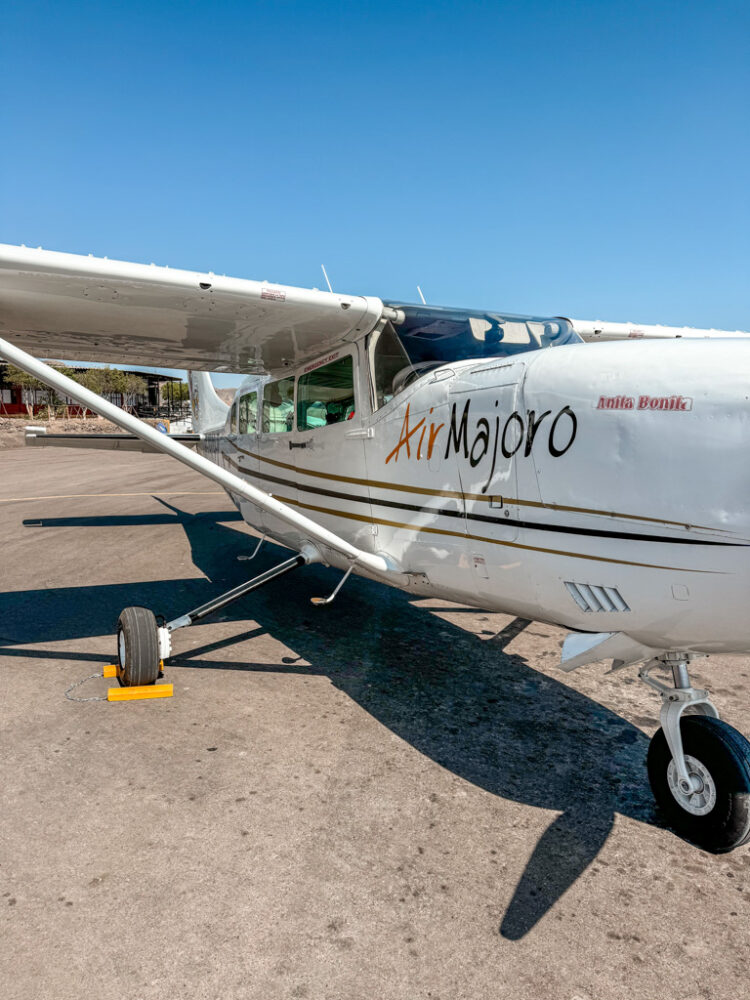
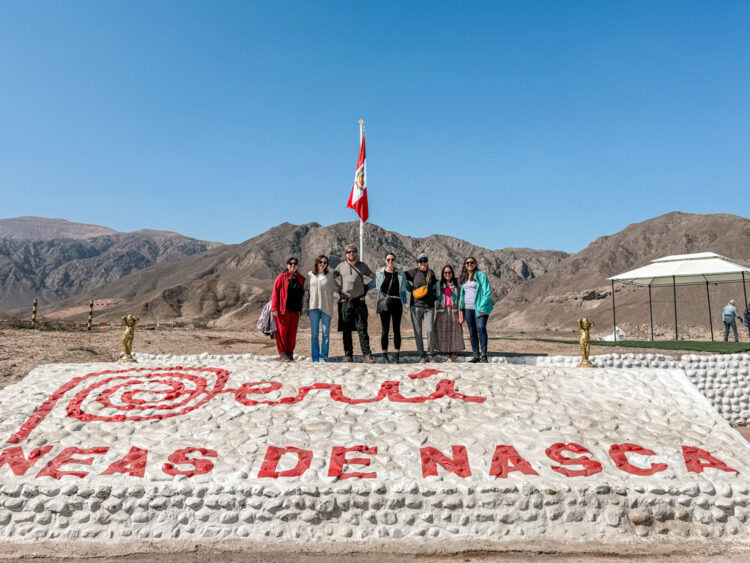
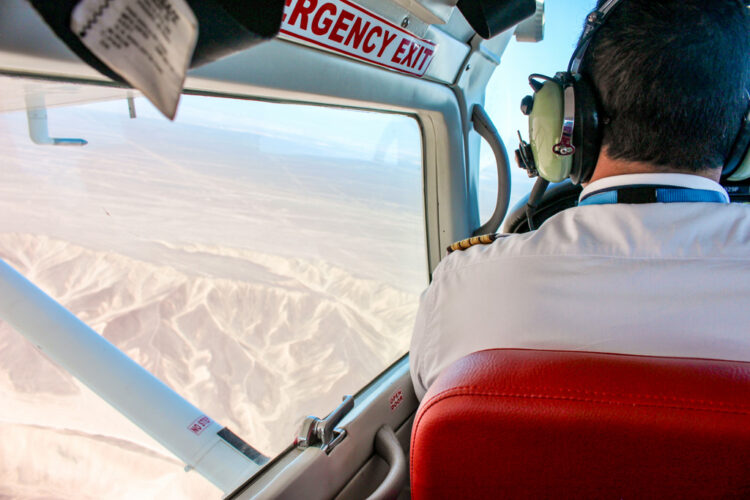
I opted to take the flight to see the geoglyphs made in the soil of the Nazca Desert (created between 500 BC and 500 AD), and while I’m glad I did it, I honestly found it a bit underwhelming because I didn’t realize how tiny the lines actually looked from above.
Definitely take some motion sickness medication beforehand since these flights are notorious for nausea due to the small planes, insane tilts, and tight circle maneuvers. Even I didn’t feel the greatest afterwards and I hardly ever get motion sickness.
Psst – this two day tour to Paracas, Huachachina, AND a flight above the Nazca Lines is absolutely perfect if you wanna see all three, and it’s a pretty good value (considering the cost of a Nazca Lines flight alone is already ~$125!).
I’m sure if you wanna continue on to Arequipa (the next stop on this 2 week Peru itinerary), you can arrange your tour to end in Nazca (instead of heading back to Lima). This is what I commonly do on day/overnight trips, and it saves so much time and money (most tour operators are totally fine with this!).
Sleep: Night Bus to Arequipa!
Our first and only night bus of this 2 week Peru itinerary! Yes, you won’t get the best nights sleep and the bus IS a whopping TWELVE HOURS, but hey, you’ll save time and money.
There’s a few bus companies, but I highly recommend Cruz del Sur (what I took!) – the bus was super comfortable with reclining seats, pretty spacious, felt safe, and there was space for our luggage underneath.
Note that you’ll need to take a short taxi ride from Huacachina to Ica, where you’ll pick up the overnight bus to Arequipa. You can also use PeruHop which is particularly designed for overseas travelers, but I’ve heard mixed reviews.
Wanna avoid the night bus? I feel you. You can simply take a day trip from Lima to Paracas and Huacachina, then head back to Lima (included in your day trip) and fly from Lima to Arequipa. Take a look at flight times to make sure this works as you may need to wait until the following morning to fly to Arequipa (it’s only a 1 ½ hour flight though so no biggie).
Day 3: Arequipa
Welcome to Arequipa, what’s commonly referred to as the “White City” due to its sillar buildings (a white volcanic stone), surrounded by volcanoes and drenched in sunshine. If you took the night bus (like I did), you’ll probably be pretty tired, but thankfully Arequipa is pretty chill and easy to love – it’s super pretty (so many volcano views!) and one of Peru’s most relaxed cities.

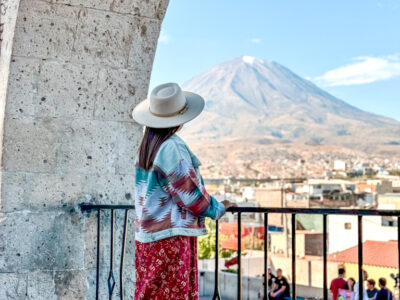
Sitting at about 7,600 ft (2,300 m), it’s high enough that you might feel the elevation slightly, but it’s nowhere near as intense as Cusco or Puno. The city is framed by three massive volcanoes (Misti, Chachani, and Pichu Pichu), which makes the views absolutely unreal, especially around sunset when everything glows gold against the white volcanic-stone buildings.
If you don’t feel like planning much (or think you’ll be too tired to navigate yourself), book yourself on an Arequipa city walking tour! You’ll see the main highlights with an expert guide all in a few hours (and it’s under $10).
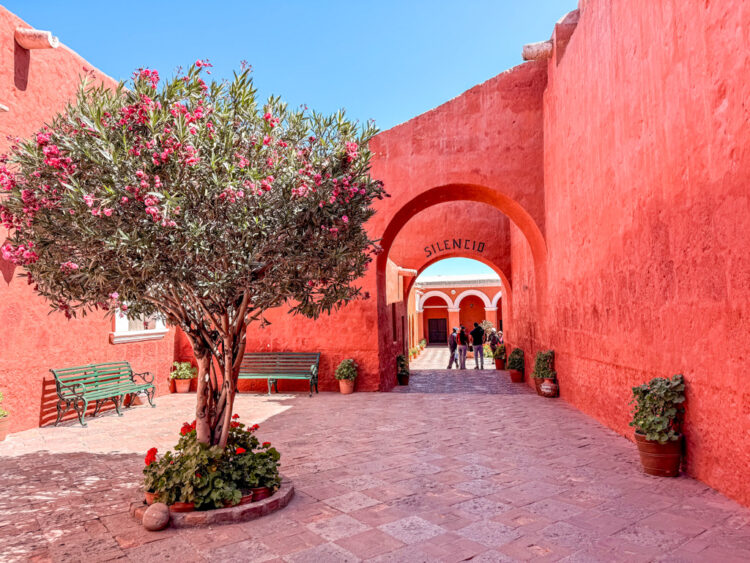
I started my day wandering the historic center, a UNESCO-listed area filled with baroque churches, palm-lined plazas, and airy courtyards. The must-see here is the Santa Catalina Monastery, basically a vibrant mini-city inside a city, with bright blue and orange walls, narrow lanes, and quiet cloisters. Give yourself a couple hours – it’s much bigger and more beautiful than you expect. We loved exploring over here, and the history is so interesting.
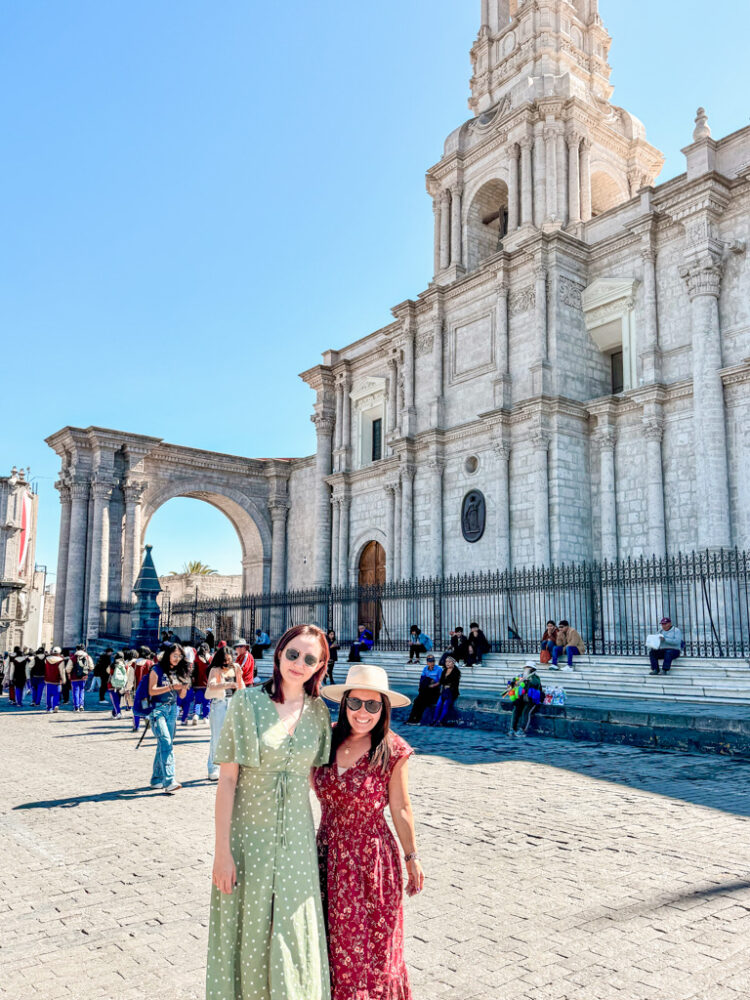
You’ll also wanna see the Plaza de Armas, which might be one of the prettiest squares in the country, and the Basilica Cathedral of Arequipa which dominates the plaza – super photogenic and even more impressive up close. Just a few blocks away, stop by the Cloisters of the Company, an old Jesuit complex with beautiful archways and stone carvings. It’s quieter than the monastery and a great place to slow down and take in the architecture.
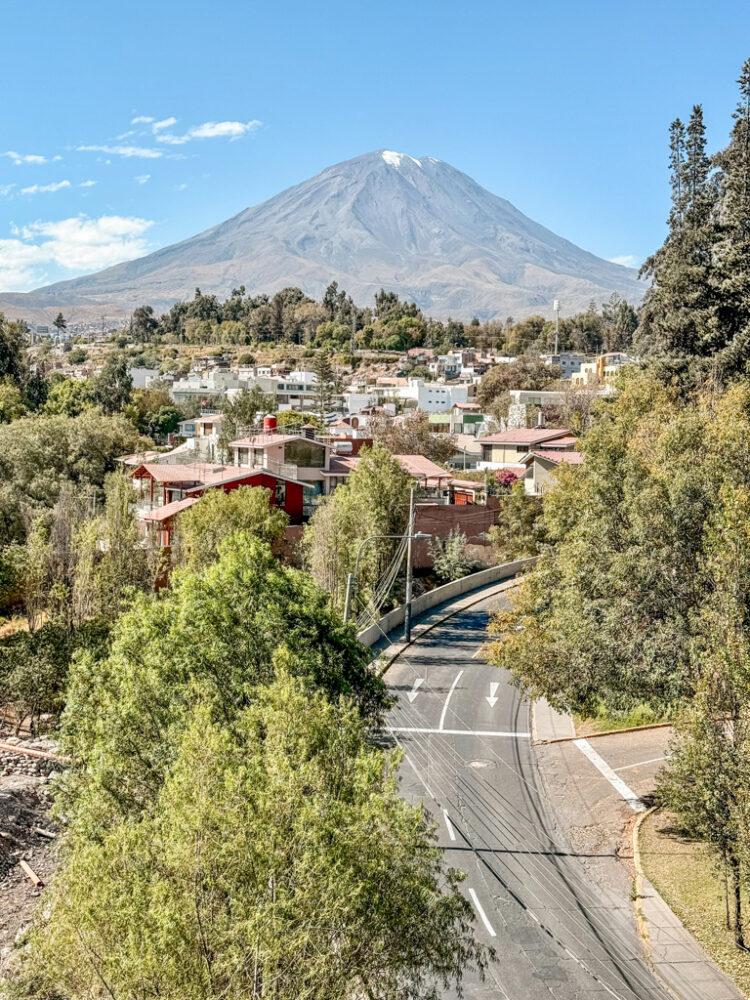
One of my favorite stops was the Yanahuara Scenic Overlook, a short ride from the center where you’ll find a wide-open panoramic view of the city framed perfectly by Volcán Misti.
After that, head to Mundo Alpaca, where you can learn about traditional weaving, see the different alpaca fibers, and yes – feed actual alpacas and llamas. It’s wholesome, it’s adorable, and it’s very Arequipa! And it was one of my favorite stops the entire day. I mean, it was the first time I saw ALPACAS in Peru, so of course I was excited! Little did I know I’d be seeing dozens upon dozens the very next day (swoon)!
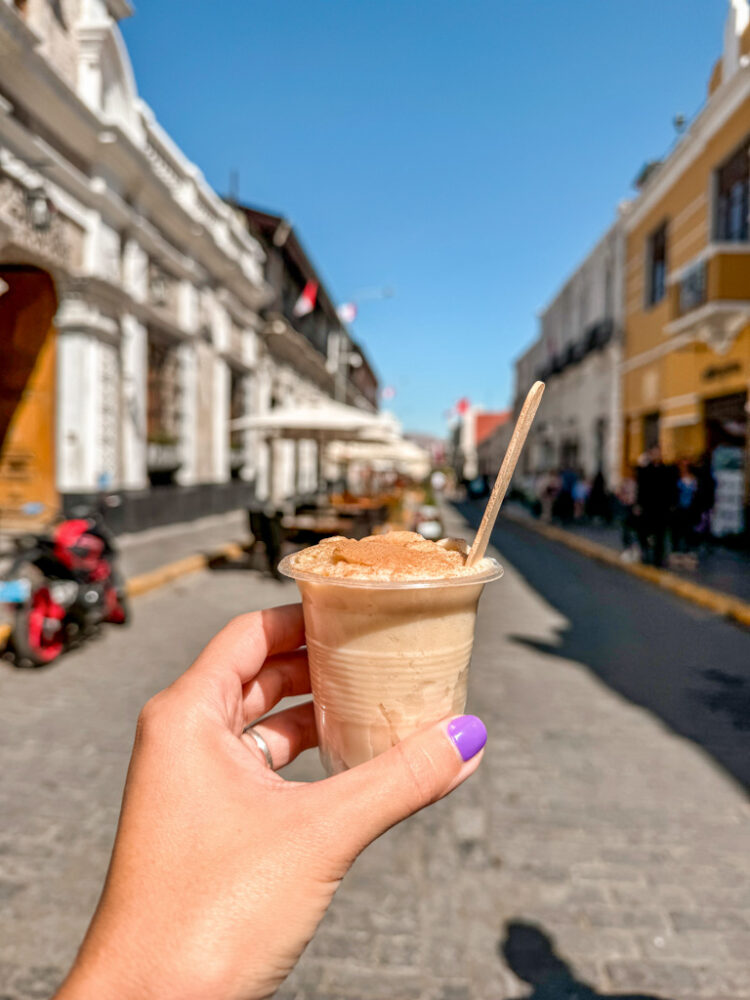
And please – don’t skip queso helado, aka “cheese ice cream.” I truly didn’t know what to expect, but it’s not cheesy at all. It’s a delicious mixture of cinnamon and sweet coconut.
I had an early night since we were up at the crack of dawn the next morning, haha. And I advise you to do the same if you wanna truly enjoy tomorrow!
Where to Stay in Arequipa
Since you only have one day in Arequipa, I highly recommend staying in the Historic Center so you’re close to all the main attractions like the Plaza de Armas and Santa Catalina Monastery. From here, you can practically walk everywhere!
There’s plenty of luxury and boutique hotels in Arequipa (like the Casa Andina Premium Arequipa, CIRQA – Relais & Châteaux, and Palacio Guaqui), but I recommend getting a more mid-range one (like the Katari Hotel at Plaza de Armas, La Hostería Boutique Hotel, or Palla Boutique Hotel) since the goal is to be out and about the whole day exploring!
If you want some time to relax, you can totally spend another day in Arequipa, and that’s when I’d recommend getting a boutique hotel with fun amenities (pool! views! etc!).
Day 4: Chivay
Get ready for one of my favorite days on this entire 2 week Peru itinerary! And it just so happens to be to a destination I had never even heard of before, haha. Funny how that happens, right?!
Day 4 kicks off your 2-day Colca Canyon adventure, and trust me – you’ll be so glad you didn’t squeeze this into a rushed day trip like some people do.
If you’re not taking a longer Peru tour like I was (hey there, G Adventures), you’ll need to book yourself on a 2-day tour from Arequipa. Thankfully this works out just perfectly, as it starts in Arequipa, takes you to Chivay (where you’ll spend the night) and then Colca Canyon the next morning, and drops you off right in Puno (for the next adventure to Lake Titicaca).
Note that the tour does NOT return to Arequipa, so be sure to bring all your stuff (luggage is ok!). You’ll need to book your own accommodation for the night, so don’t forget to do that (thankfully hotels are not expensive in Chivay).
Regardless of whether you’re on a multi-week tour or simply this 2-day one, prepare to leave Arequipa super early in the morning. You’ll start by climbing into the Andes for one of the most dramatic landscapes in southern Peru!
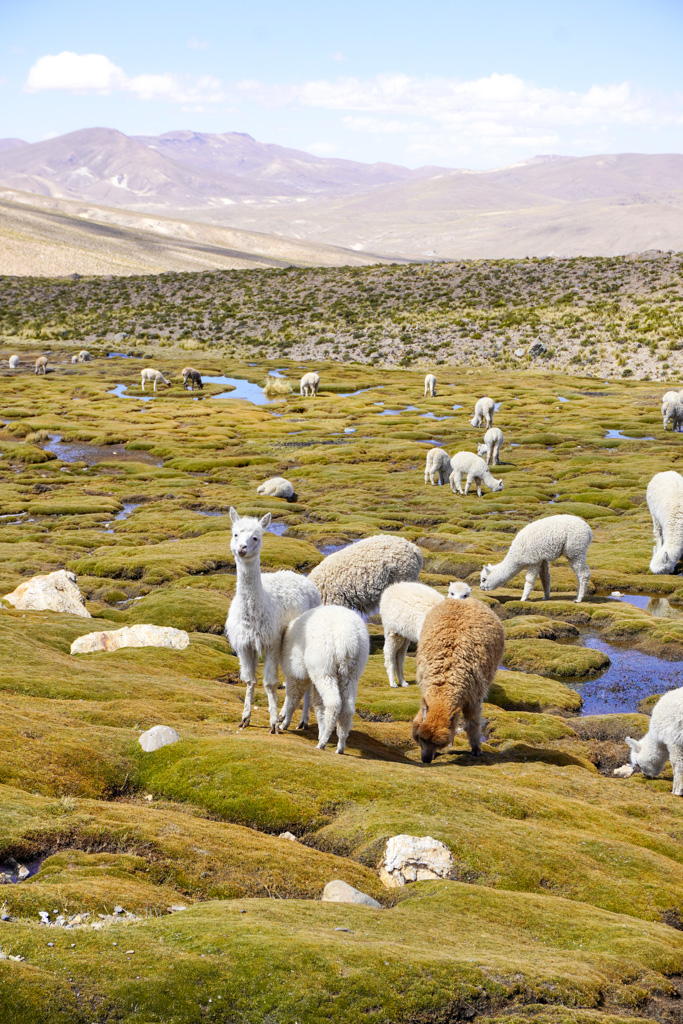
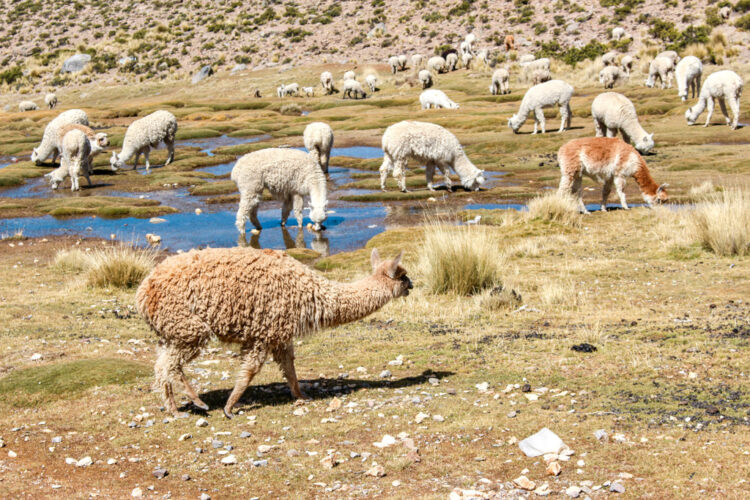
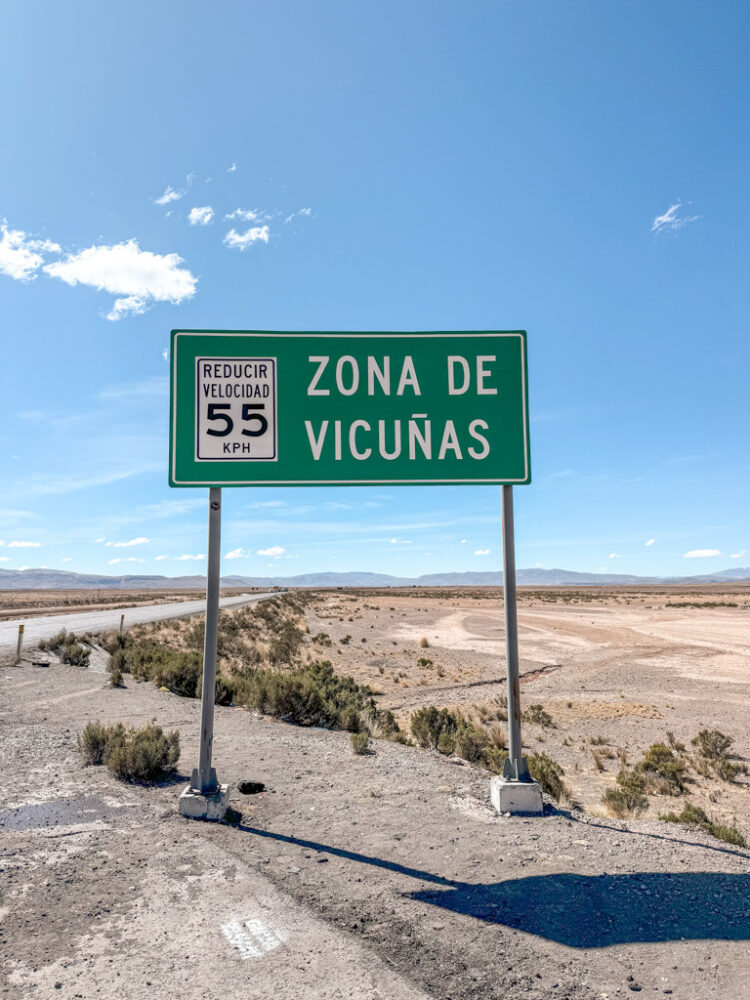
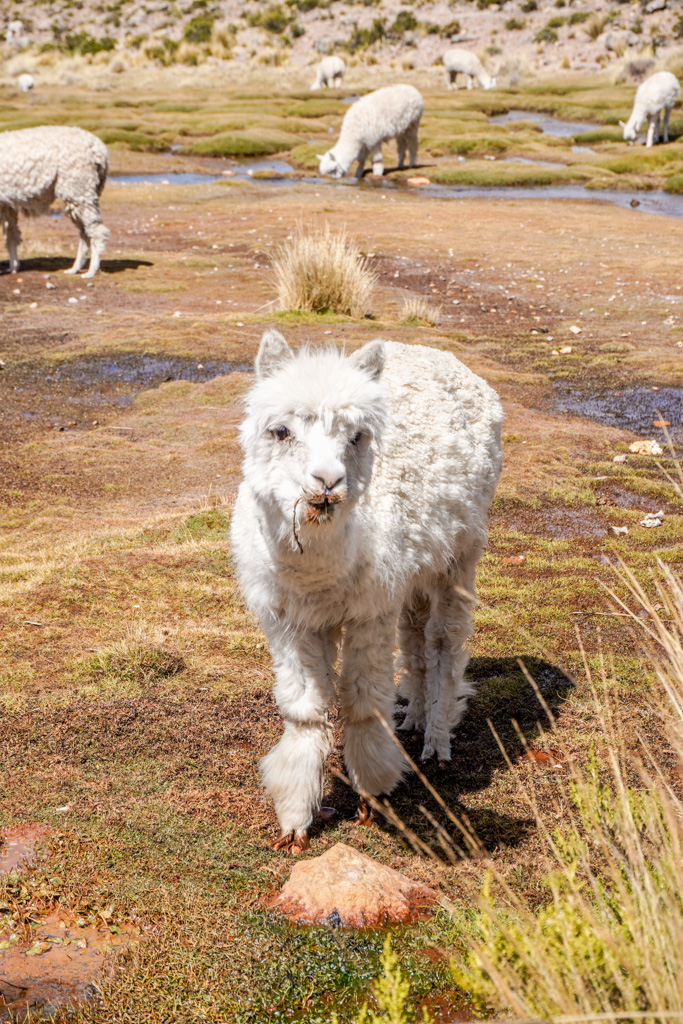
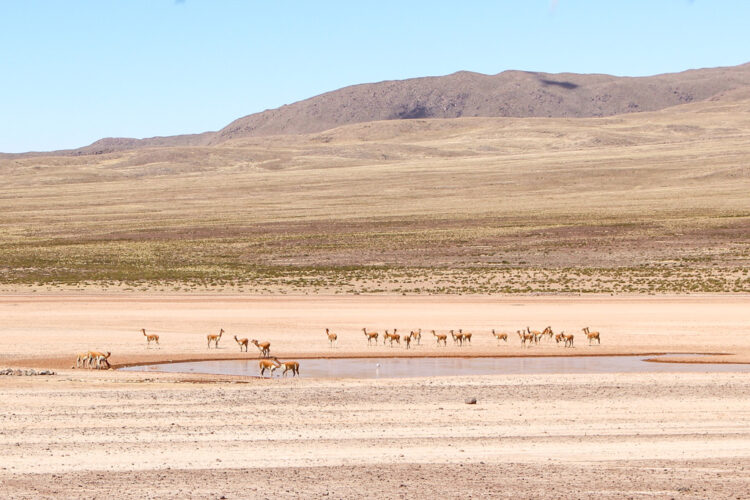
The drive alone is gorgeous: wide-open altiplano views, rolling volcanic hills, and herds of llamas, alpacas, and wild vicuñas literally everywhere. Your guide will likely stop at a few wildlife lookouts so you can take photos and stretch your legs. This was one of my favorite days on my entire 2 week Peru itinerary, namely because of all the wildlife we saw. I mean, look at how cute they are!
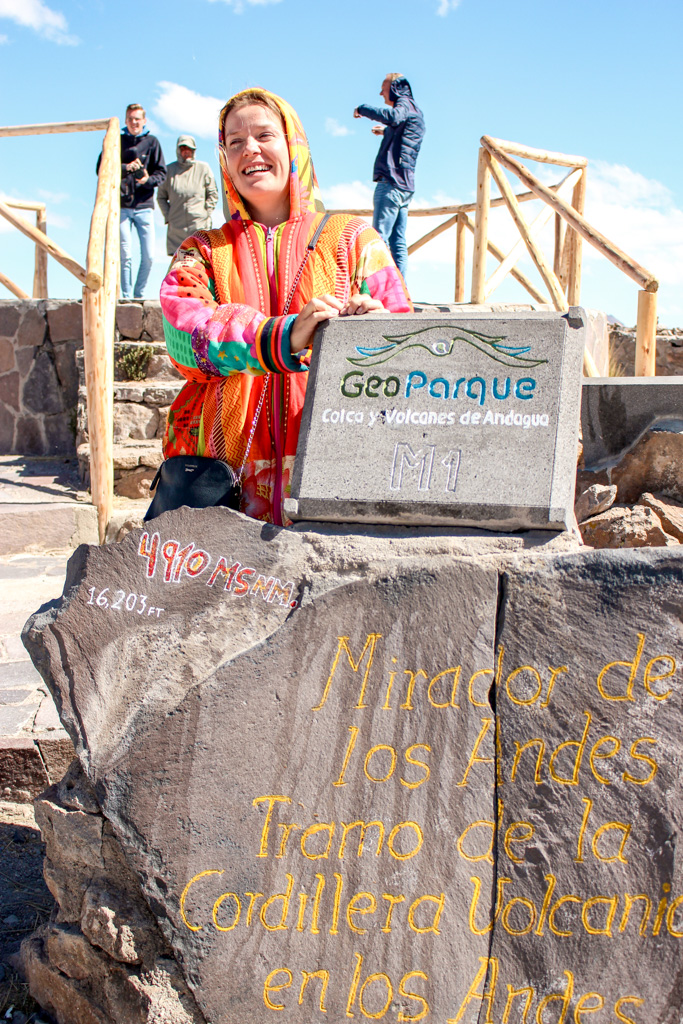
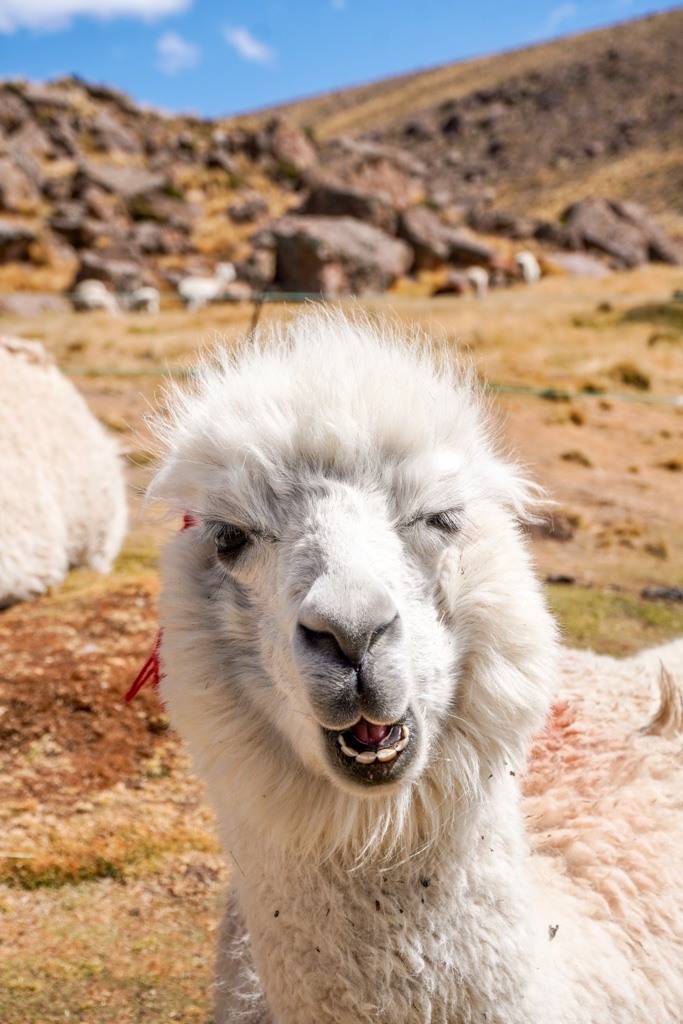
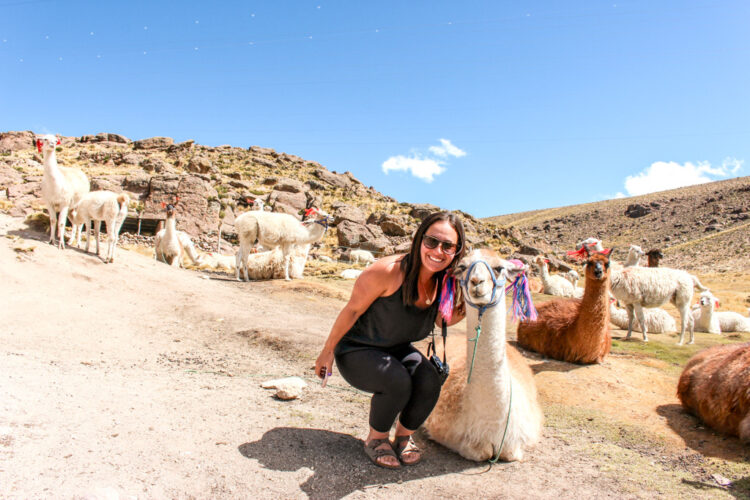
Along the way, we stopped at the National Reserve Salinas y Aguada Blanca, where we saw llamas, alpacas, and vicuñas (wild relatives of llamas and alpacas) for the first time. We even stopped by a lake to see flamingos! And Mirador de los Andes (at a whopping 15k feet/4910m) for amazing views of the volcanic mountain range – this is where I definitely felt the altitude a little (it’s SO high up!).
By early afternoon, you’ll arrive in Chivay, a small Andean town that serves as the main base for exploring Colca Canyon. It’s simple, local, and surrounded by mountains – and it’s where most tours spend the night, including mine! This is exactly why doing the canyon as an overnight trip is such a game changer.
After checking into your hotel in Chivay, wander the small main square, grab a warm Andean dinner (try alpaca steak, quinotto, or arequipeño soups), and then head to the La Calera Hot Springs to unwind.
The water is toasty, the mountain views are unreal, and it’s the perfect way to prepare for tomorrow’s early start in the canyon. We had to walk over a questionable wooden planked bridge (go carefully) – but we made it! It was very no frills but still very fun, and perfect after a long day on the bus.
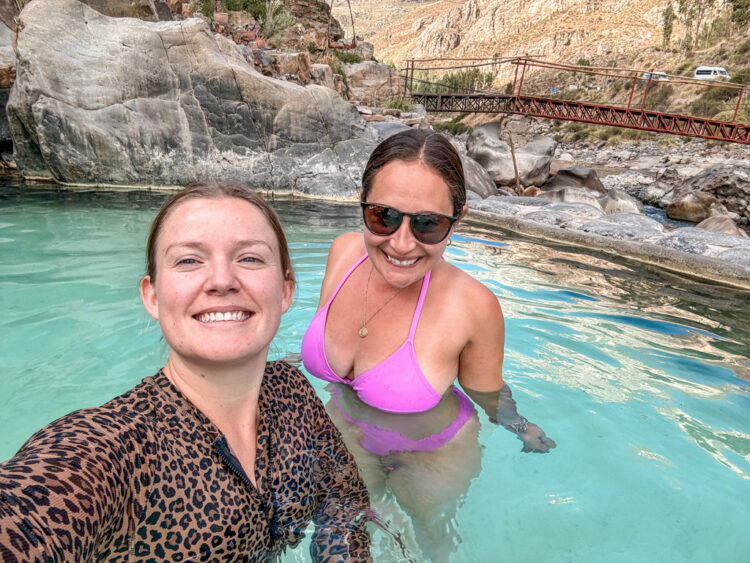
Note that you technically can do a day trip to Colca Canyon from Arequipa… but I really don’t advise it. By staying overnight you can enjoy La Calera Hot Springs at sunset (the BEST after a long day), grab dinner, and actually sleep like a human instead of doing a 3am-to-7pm day trip. It also makes your onward journey to Puno (tomorrow) much smoother (no back-to-back 14-hour travel days).
Where to Stay in Chivay
If you’re only spending one night in Chivay, it’s best to stay within walking distance of the Plaza de Armas, the small town’s central hub. This area has most of the hotels, restaurants, and tour pickups, making it easy to grab dinner, wander the market, and head out early the next morning for the Colca Canyon viewpoints. A few spots to choose from: Casa Andina Standard Colca, Casita Azul, and Pascana Hotel.
Day 5: Colca Canyon → transfer to Puno
Time to see the legendary Andean condors!
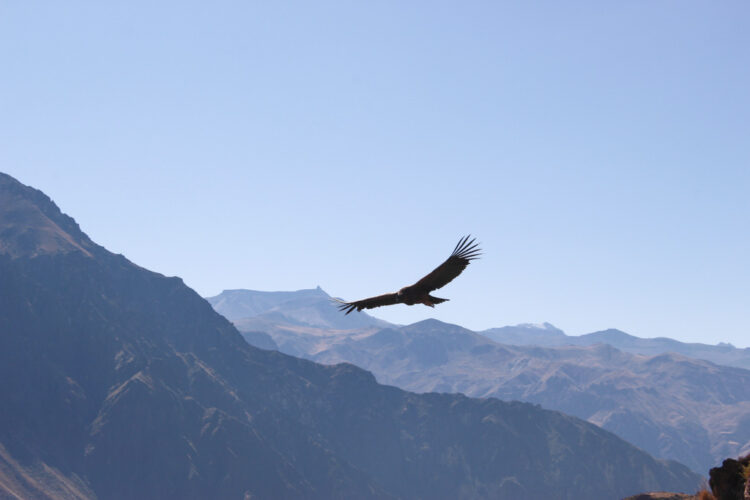
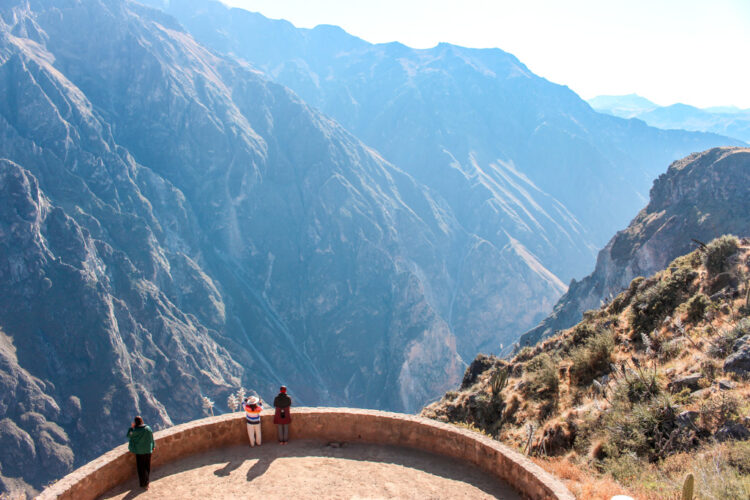
After breakfast in Chivay, make your way into the heart of Colca Canyon, stopping at several viewpoints as the valley gets deeper and the scenery more dramatic. The big highlight of the morning is the legendary Cruz del Condor viewpoint – this is where the massive Andean condors (with 10-foot wingspans!) catch warm air currents and glide right over your head. It’s crazy and feels completely surreal.
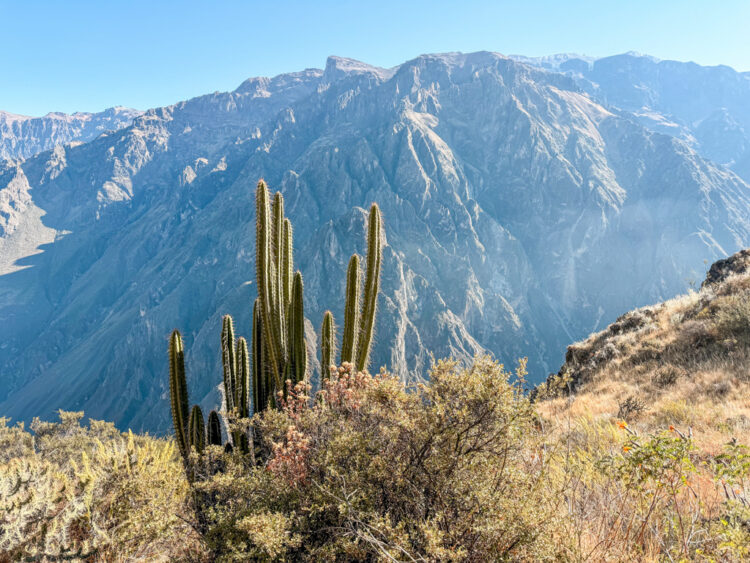
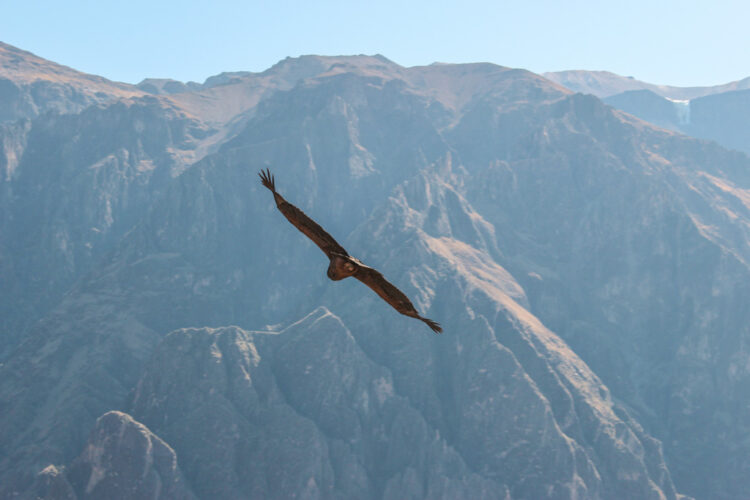
We did a short hike to the viewpoint, and at first didn’t see any condors, and then BAM – there they were! You gotta go early for the best chance at sightings, and everyone knows this, so there’ll undoubtedly be a big crowd.
After being wowed by the condors (they’re truly spectacular), you’ll continue through small villages, agricultural terraces, and a bunch of roadside lookouts. Some tours stop at Maca, a tiny highland town with a photogenic church and local women selling souvenirs (yes, you can take photos with their alpacas – but tip respectfully!). You’ll also see more vicuñas, farmlands, and sweeping Andean landscapes as you move toward the high pass separating Colca from the altiplano.
Around midday, you’ll leave the canyon behind and start the long but scenic drive to Puno, climbing once again to altitudes around 15,000 ft (4,800 m) before descending toward Lake Titicaca. This direct transfer is the reason the 2-day Colca itinerary works so well – you skip the backtracking to Arequipa and save hours of transit.
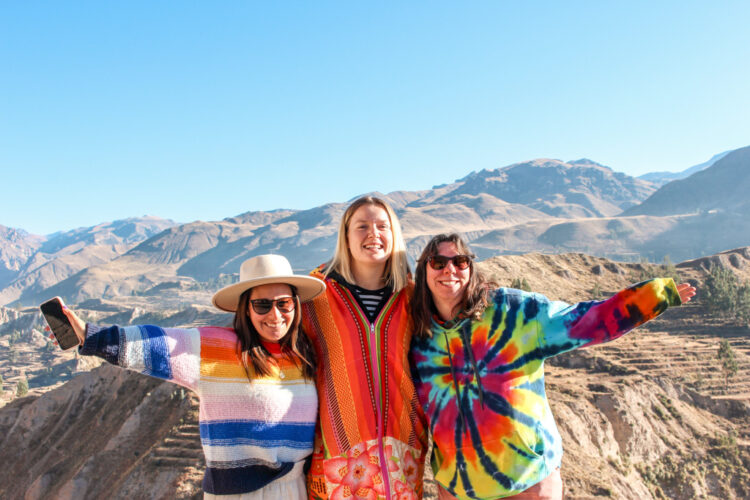
Prepare to roll into Puno in the late afternoon or early evening. The town isn’t the most charming place in Peru, but it’s the gateway to Lake Titicaca. I spent my evening wandering the pedestrian street, browsing colorful craft stalls, and picking up a super cute woven ear warmer I wore the next few days (much needed – it gets cold up here!). I also stopped by Puno Cathedral, the big stone church overlooking the main plaza.
Grab dinner early, hydrate well (you’re at 12,500 ft / 3,800 m now), and rest up – tomorrow is homestay day on Lake Titicaca, one of my most memorable experiences in Peru.
Where to Stay in Puno
If you’re only staying one night in Puno, it’s best to book a hotel near the Plaza Mayor de Puno so you’re close to restaurants, shops, and tour agencies.
Most boat trips to Lake Titicaca and the famous Uros Floating Islands depart early in the morning, so staying centrally makes logistics much easier. Being in the heart of town also lets you quickly explore the main square and grab dinner before your early start the next day.
Check out these spots: Tierra Viva Puno Plaza and Casa Panqarani.
Day 6: Lake Titicaca Homestay
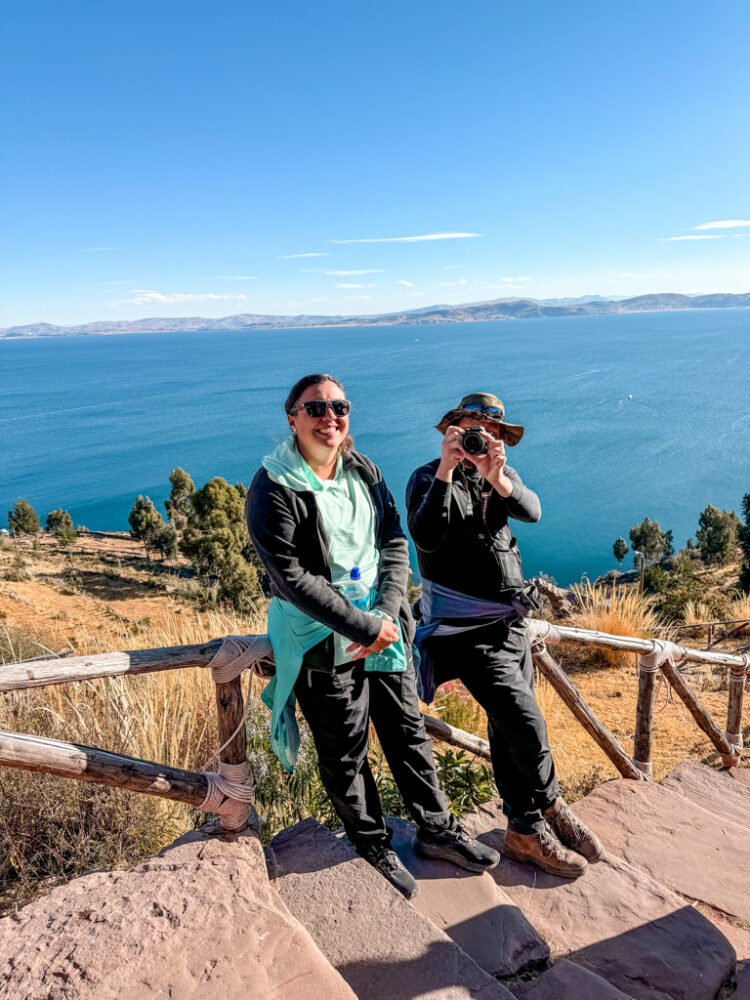
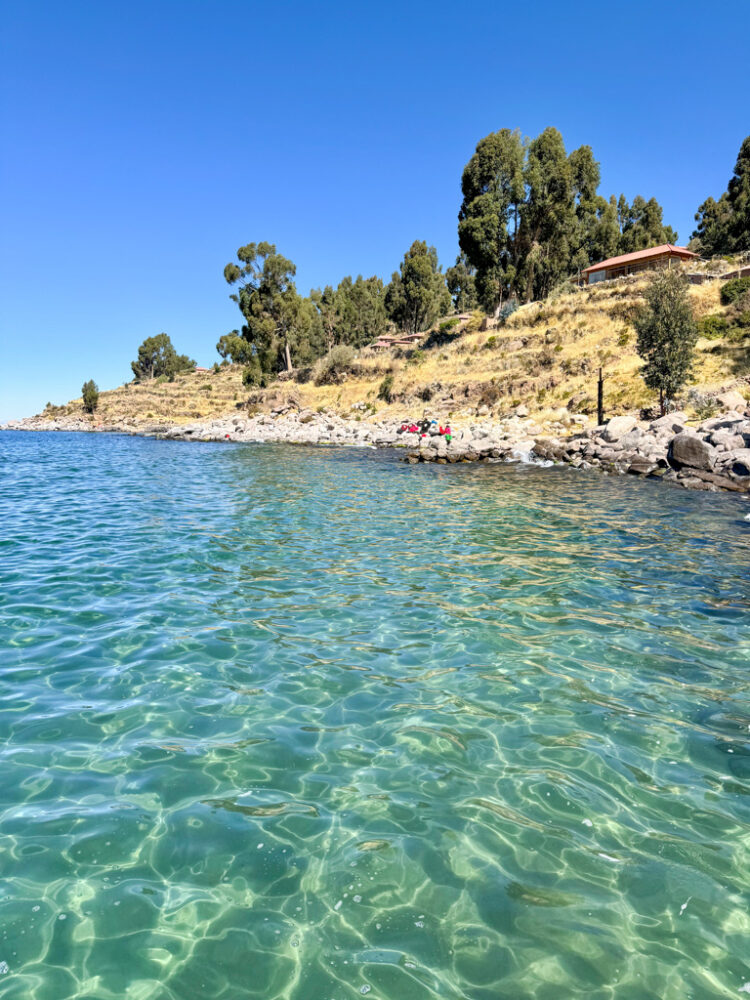
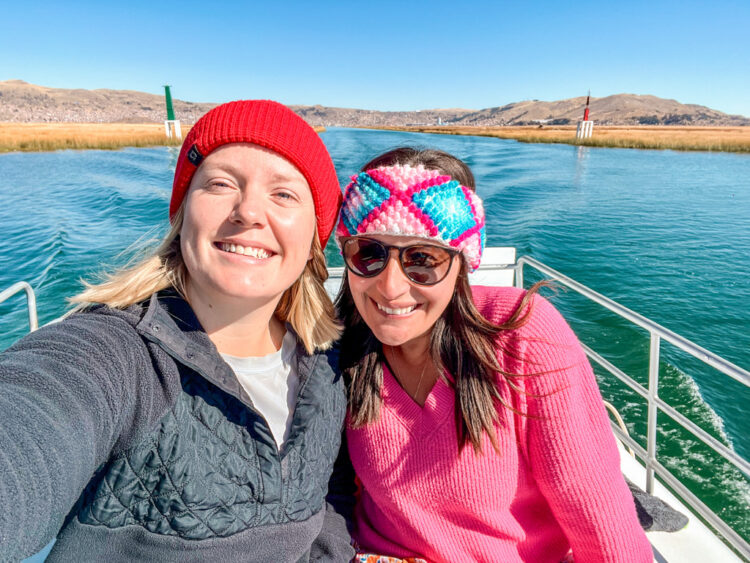
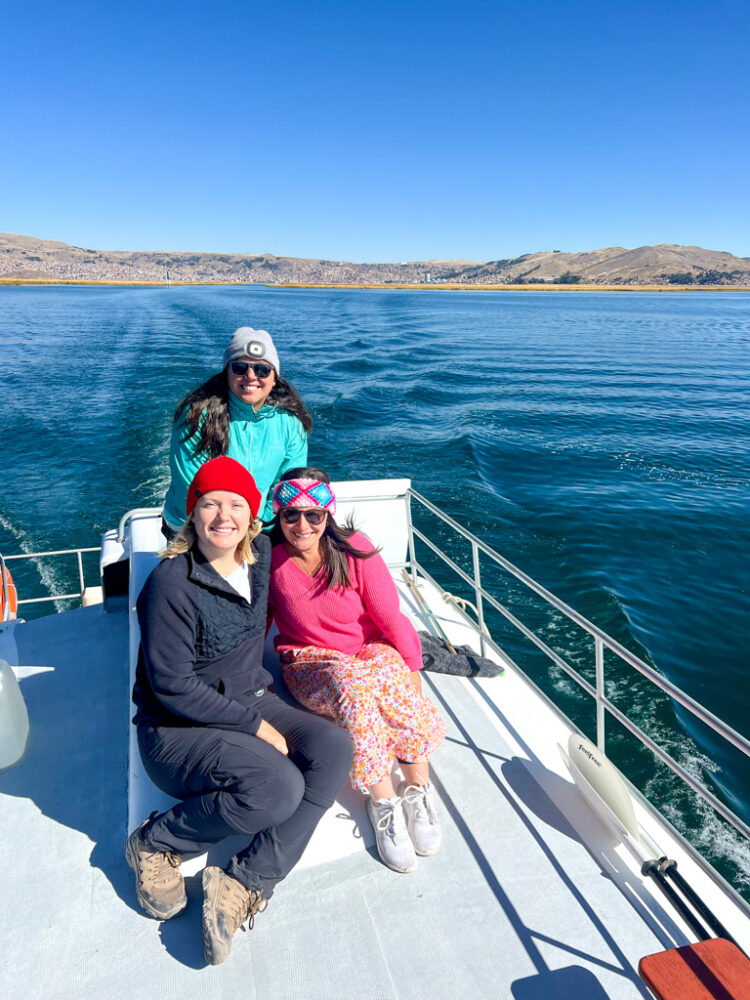
Today is one of the most memorable (and most heart-filling) days of the entire trip. You’ll start the morning with a boat ride out onto Lake Titicaca, a large freshwater lake in the Andes that sits along the border of Peru and Bolivia. It’s also known as the highest navigable lake in the world, so be sure to bundle up – it was so cold!
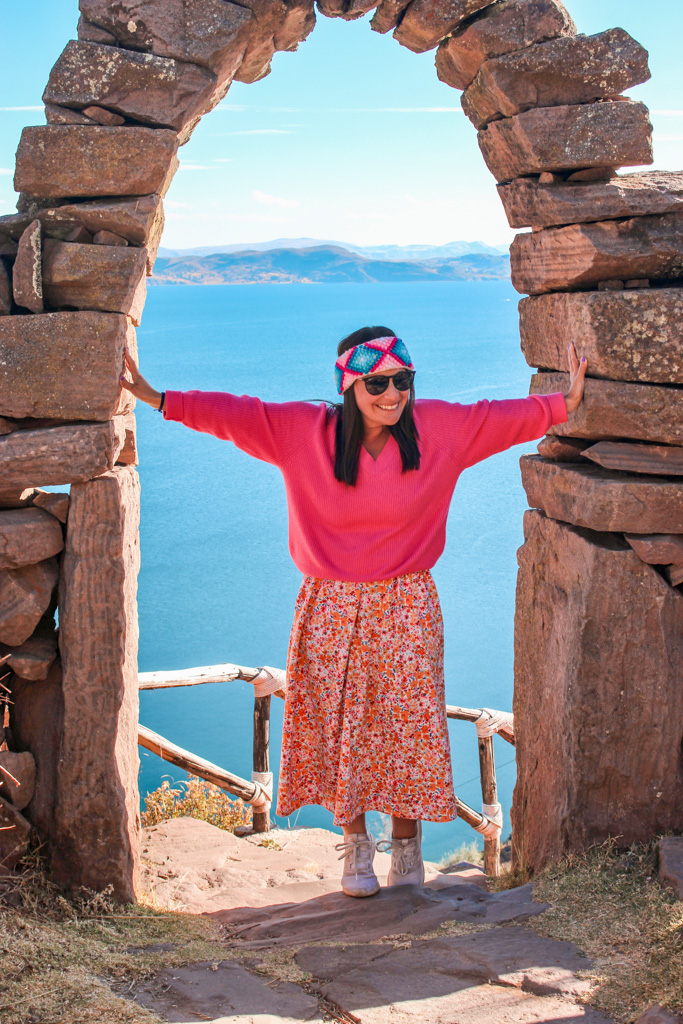
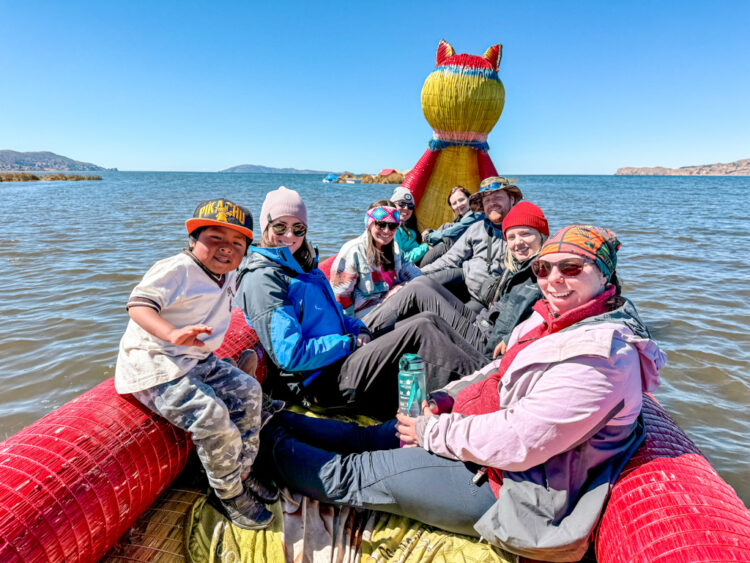
Most tours (like this one!) follow the same general itinerary: a tour of Uros Floating Island, hiking on Taquile, then meeting up with your homestay family on Isla Amantani. This other tour is very similar if that one gets booked up!
First up – the Uros Floating Islands, a cluster of artificial islands built entirely from layers of totora reeds. Yes, it’s touristy – there’s no getting around that – but it’s also fascinating to learn how these communities construct, maintain, and live on floating land. Made entirely out of reeds, themselves! We took a quick ride on one of their reed boats and checked out their super colorful artwork before continuing deeper into the lake.
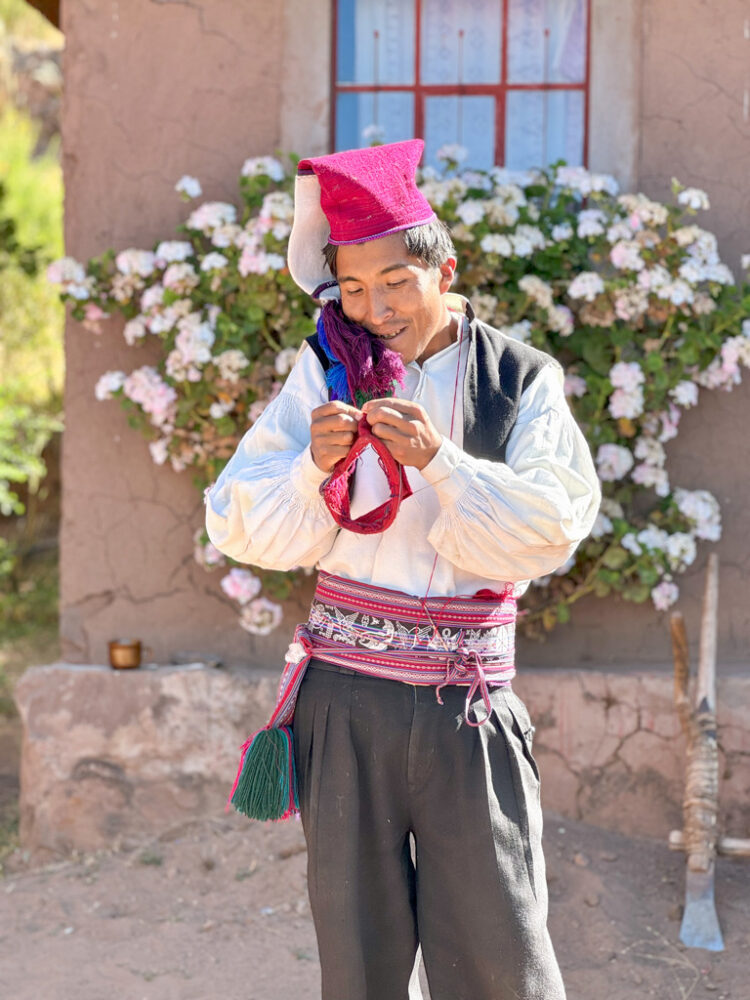
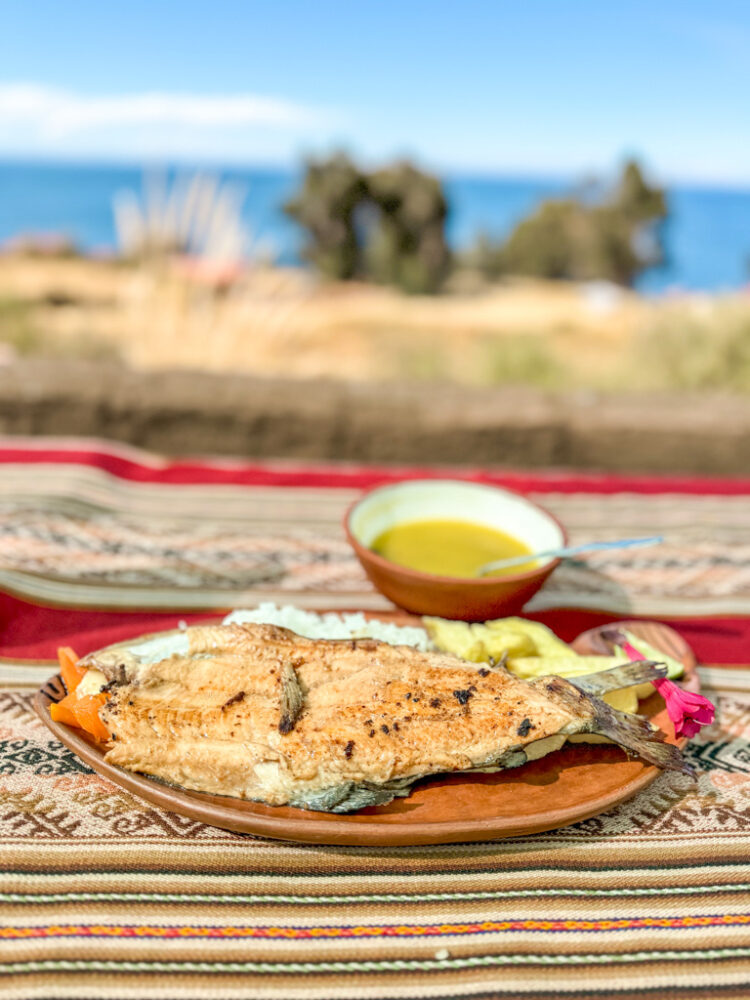
Next comes Taquile, a gorgeous island known for its terraced hillsides, weaving traditions, and fresh trout lunches. I hiked around Taquile for a bit – nothing too strenuous but enough to get those stunning panoramic views – and stopped for a plate of unbelievably fresh trout. SO good.
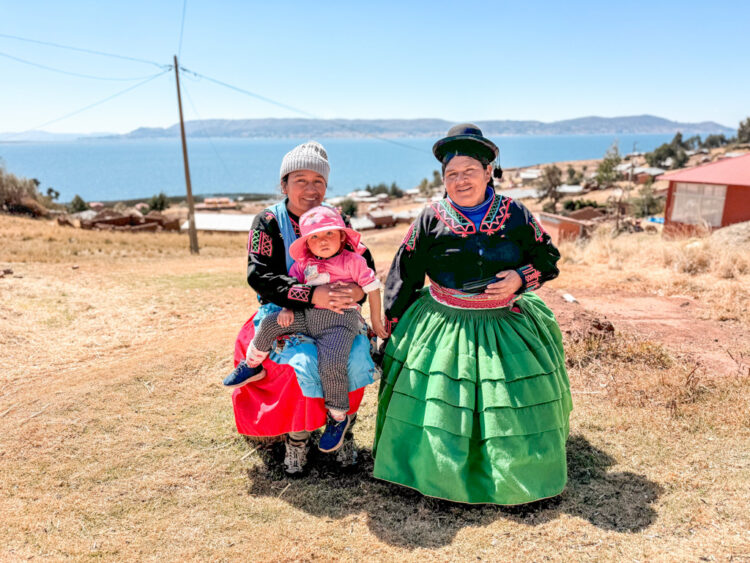
In the afternoon, we headed to the area designated for our homestay, Amantani Island, where we met our host family for the night. The accommodations were simple but cozy, and the experience is incredibly genuine.
My hosts spoke Quechua, so we communicated in Spanish… which was neither of our first languages. Somehow, between smiles, hand gestures, and the occasional confused stare (yup…), we totally made it work.
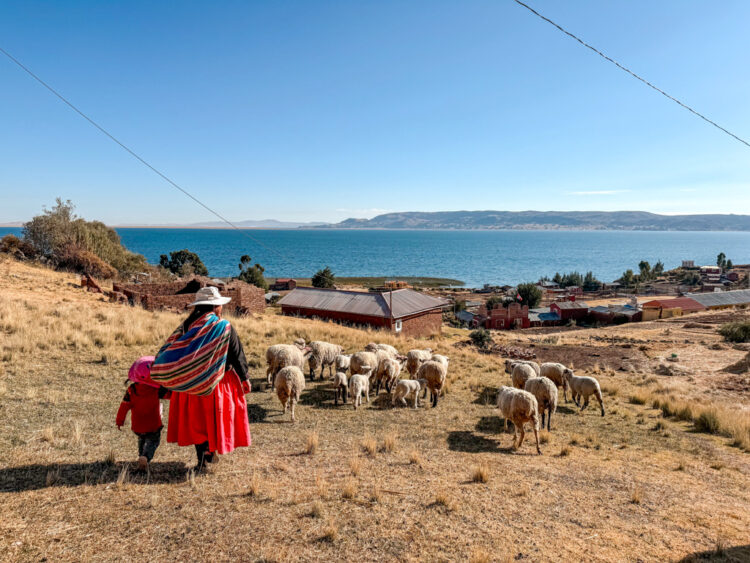
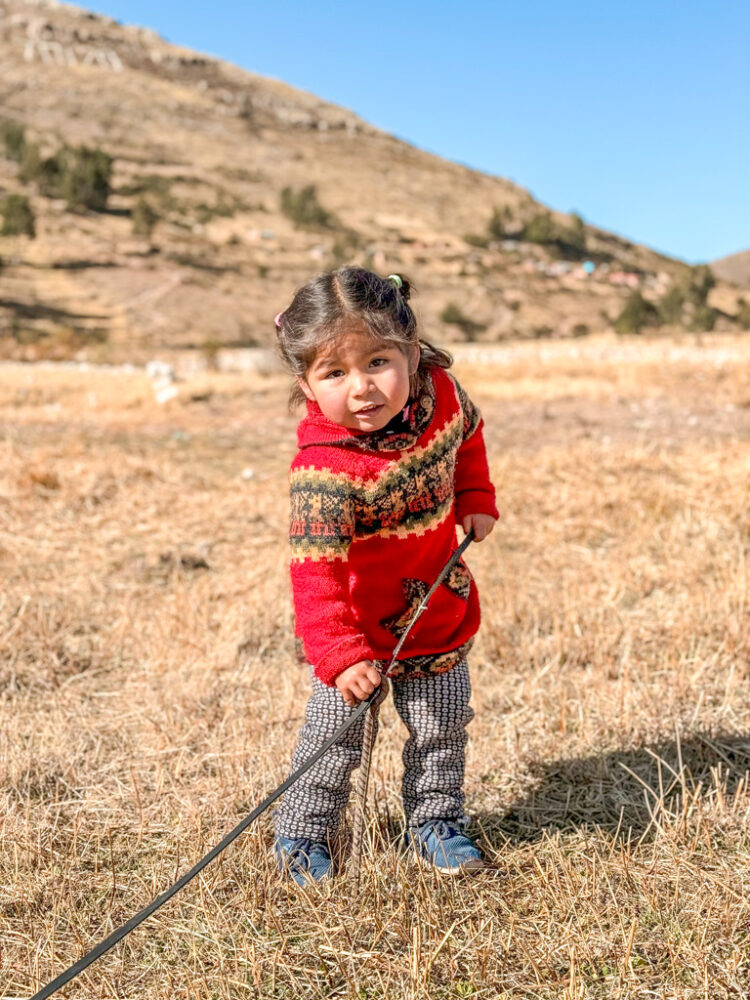
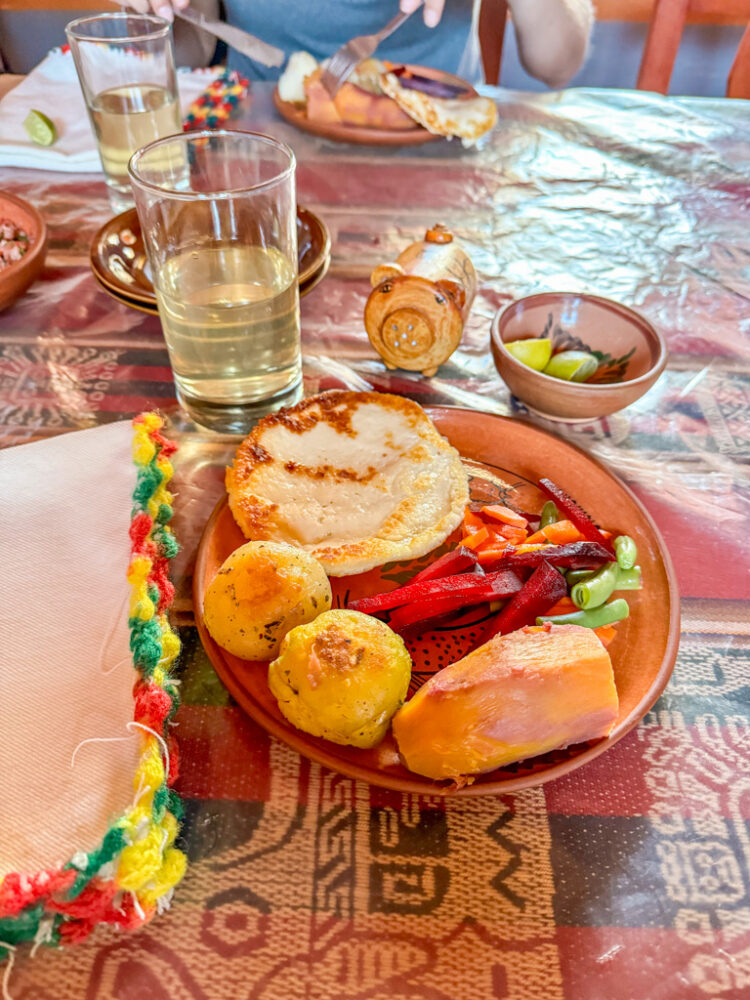
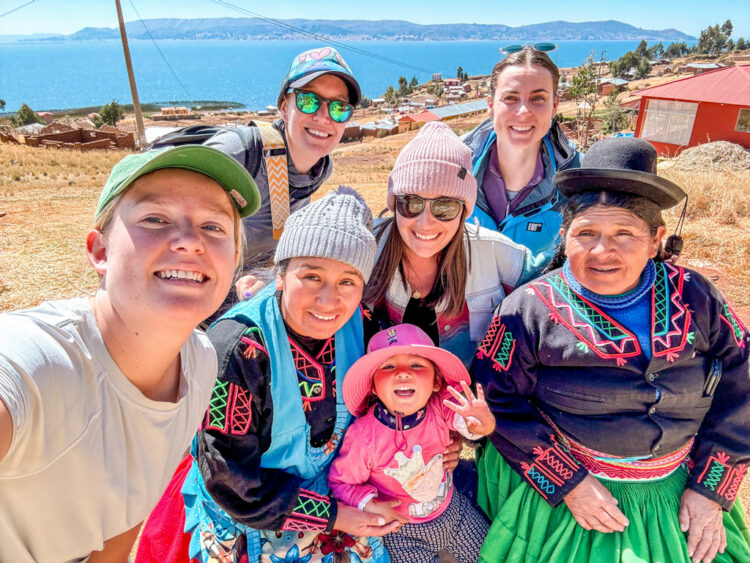
Our family was unbelievably welcoming. We stayed with a wonderful couple and their adorable 3-year-old daughter, Valentina, who instantly stole everyone’s hearts. We even helped with their daily chores – herding sheep (which I was absolutely horrible at!), sorting what felt like millions of lima beans (such a great arm workout), and just watching their daily life unfold. Dinner was homemade (lots of potatoes, always delicious), and we ate together at their small kitchen table.
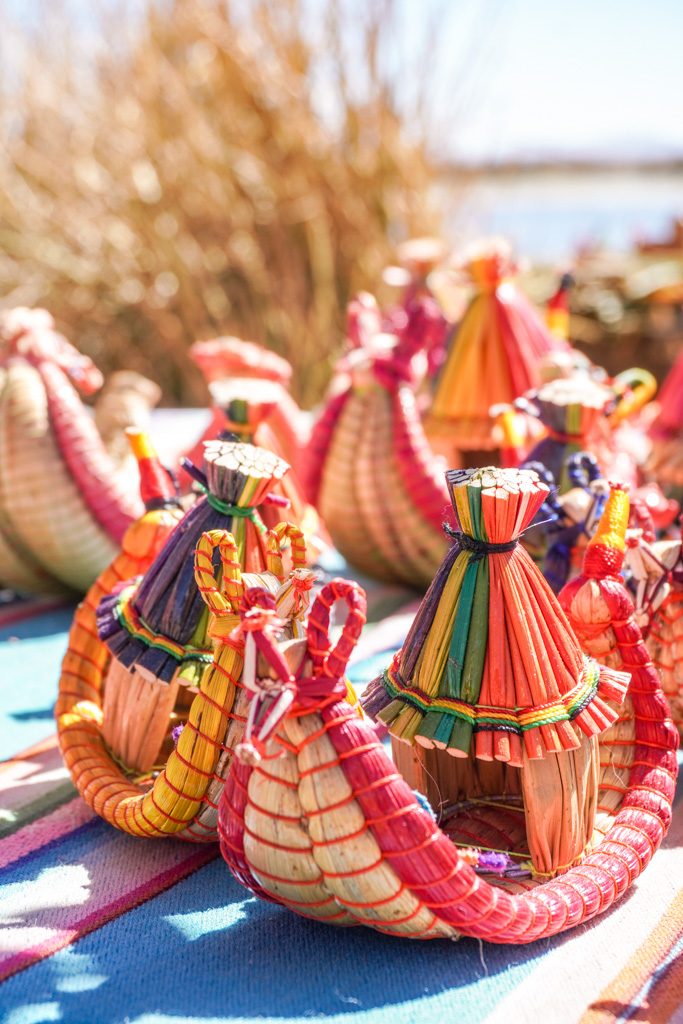
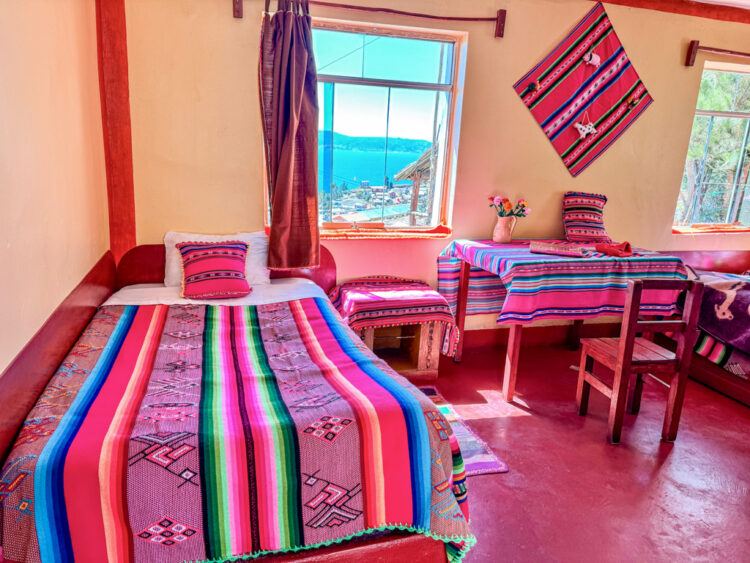
At night, we slept in a modest room lined with the most colorful Andean blankets and bed linens. It was freezing, but our hosts piled us high with warm, heavy blankets, and we were super cozy.
Make sure to look up at the sky before bed – it’s one of the darkest I’ve ever seen. This is where I spotted the Milky Way with my naked eyes for the first time, and truly, no photo or description comes close. One of those nights I’ll never forget!
Homestays rotate among different families so everyone in the community gets an equal chance to host and earn income. It’s wholesome, meaningful, and such a special way to see life on Lake Titicaca up close. After dinner and (possibly) a little traditional dancing, tuck in early – tomorrow is another big day.
Where to Stay: A homestay on Tacquile or Amantani Island!
Day 7: Travel Day to Cusco
Today’s mostly a travel day, and no matter how you get from Lake Titicaca to Cusco, it’s gonna take up most of the afternoon. After saying goodbyes to your homestay family, head back to Puno in the early afternoon and start making your way to Cusco. There’s a few ways to get there, and honestly… none of them are perfect, but some are definitely better than others.
If you want the fastest option, you can fly — but it’s a bit of a headache. You’ll have to go Puno → Juliaca Airport → Lima → Cusco, which feels like you’re practically flying back home before returning to the Andes. It’s a long travel day, but you’ll still reach Cusco earlier than any ground transport.
There’s also a tourist train from Puno to Cusco, which only runs on Tuesdays and Thursdays. It’s undeniably beautiful – the train snakes past high-altitude plains, tiny rural villages, llamas, alpacas, and huge Andean peaks. You’ll get a fancy onboard meal, and it’s a fun “once in a lifetime” way to see the landscape. But it is pricey (usually around $100-$200+ depending on the season) and definitely geared toward tourists. If you’re short on time, it’s also slow.
The last option (and my personal pick): the bus. The direct route is around 7 hours, and companies like Cruz del Sur run comfortable buses with reclining seats, bathrooms, and decent legroom. It’s not glamorous, but it’s not miserable either – bring snacks, download a Netflix show, and you’re good to go. Plus, no airport chaos.
If you have an extra day for this 2 week Peru itinerary, you may wanna relax in Puno for a bit and take an early morning bus the next morning (which is what I did). BUT don’t fret – you can always take a night bus (yes, again), if you’re trying to squeeze everything in.
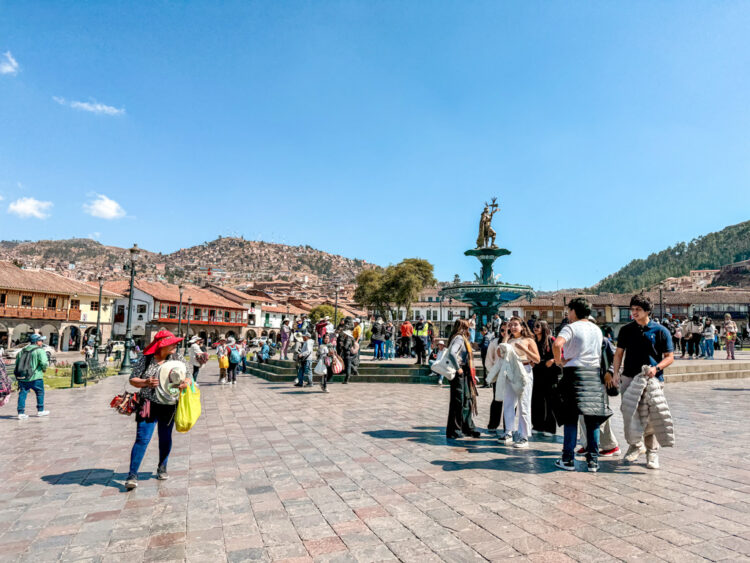
Regardless of how and when you arrive in Cusco, the second you step off the bus or plane, take it slow. Cusco sits at 11,152 feet (3,400 m), and it hits harder than Puno for a lot of travelers even though the elevation is similar – probably because Cusco’s hills make you work for every breath. Drink water, avoid any big meals, and save the pisco sours for tomorrow.
If you’re feeling up for it, wander around the Plaza de Armas, grab an easy dinner, and get some rest. You’ll want your energy for the next few days, especially tomorrow’s early morning wake up call. Eat well, drink water, and sleep early. The next few days are… busy.
Where to Stay in Cusco
There’s SO many options in Cusco, from simple hostel beds to luxury boutique hotels. Just be sure to choose something near the main square!
Here’s a few highly-rated options: Black Llama Hostel Cusco ($), Hotel Hacienda Sonqori Centro Histórico ($), El Mariscal Cusco ($), Casa Matara Boutique ($), Wyndham Costa del Sol Cusco ($$), Aranwa Cusco Boutique Hotel ($$), Palacio del Inka, a Luxury Collection Hotel, Cusco ($$$), Monasterio, A Belmond Hotel Cusco ($$$$ if you’re feeling fancy/celebrating a special occasion).
Day 8: Rainbow Mountain
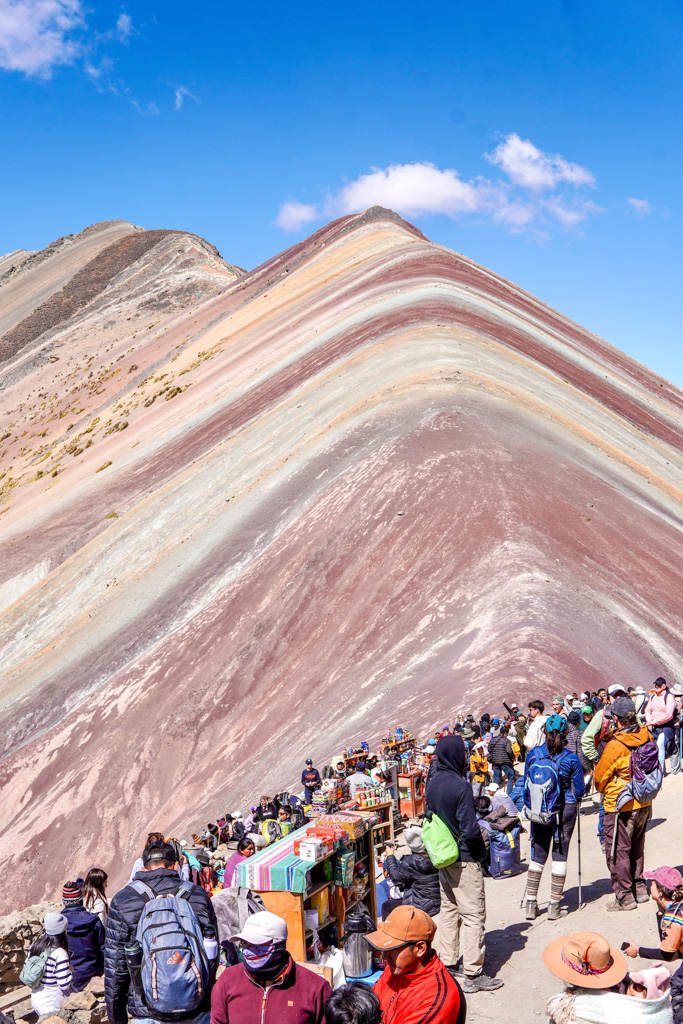
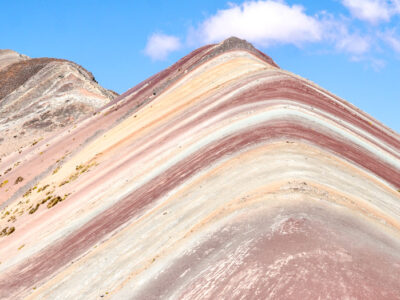
Get ready for yet another early morning wake-up call (I was picked up at 4am!) – today’s the day we head up to Rainbow Mountain, also known as Vinicunca! I’m sure you’ve seen photos of it before – it’s been plastered all over social media for so long. As soon as I started planning my Peru itinerary, I knew this needed to be included.
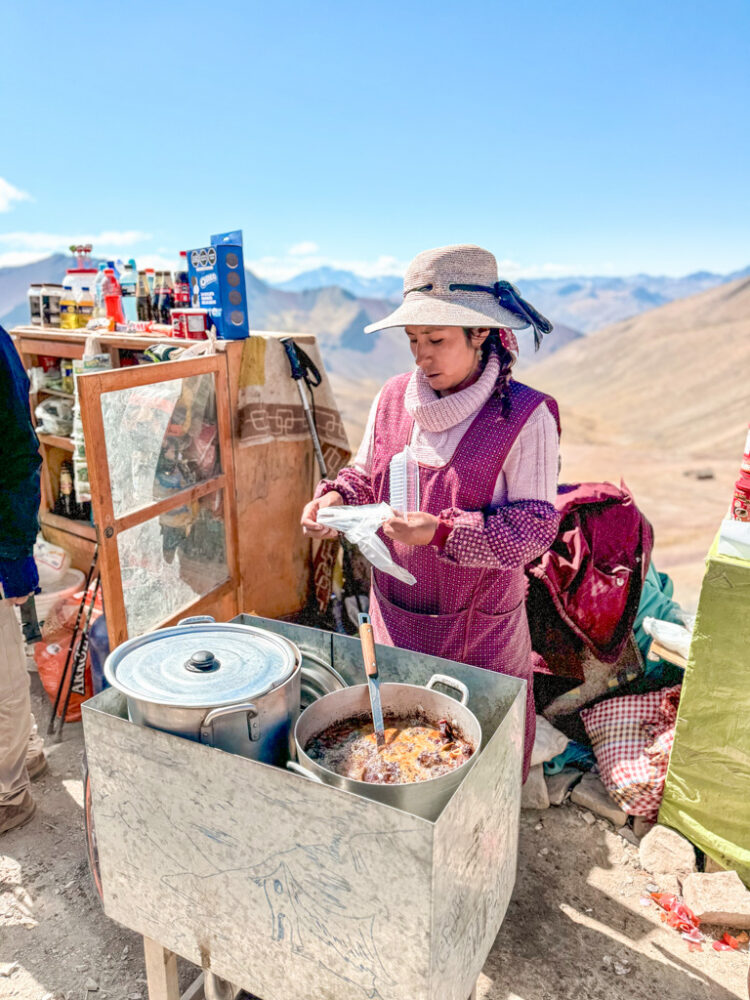
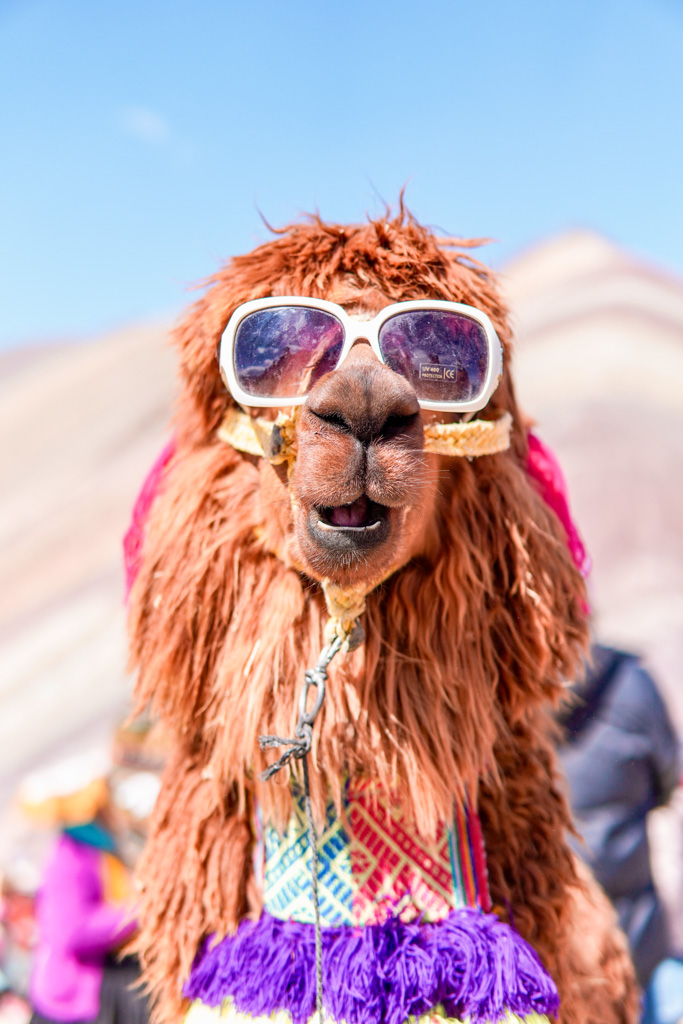
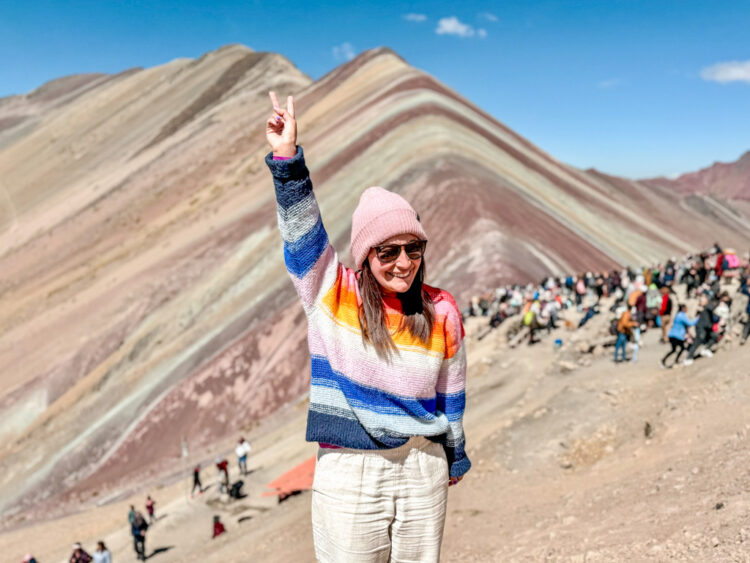
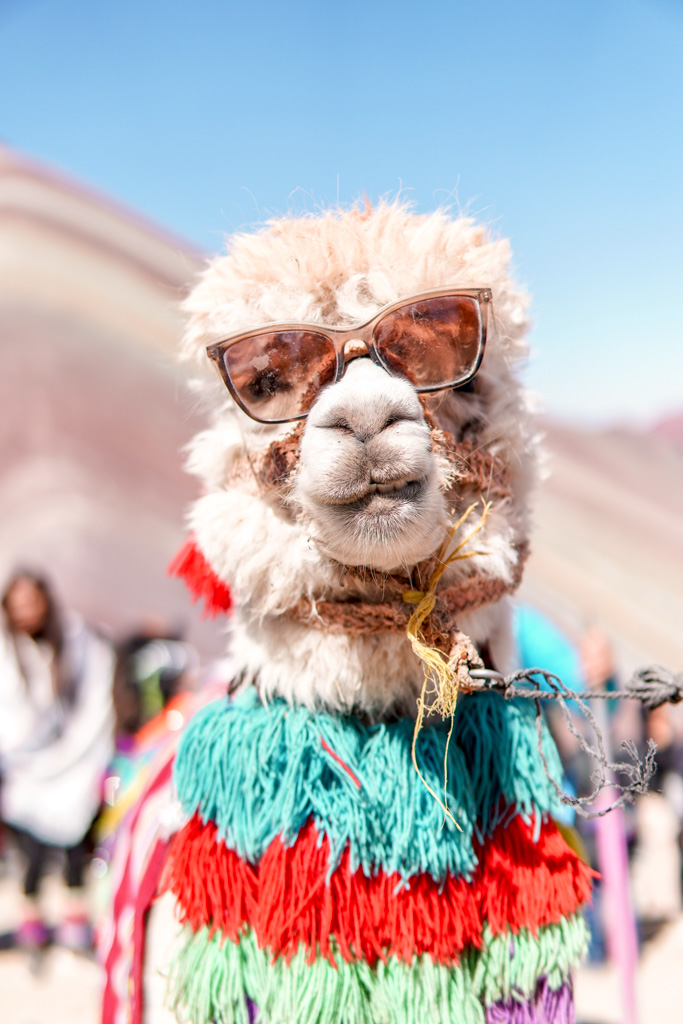
Honestly, it’s a bit of a slog with the altitude and the cold, but once you see those layers of red, gold, and teal stretching across the mountainside, it’s so worth it. The Andes are all around you, and even though it’s a popular spot, the views are still massive and kind of mind-blowing. Just remember – it’s high up, it’s chilly, and it’s going to take some energy, but that’s part of the adventure. I also had so much fun taking pictures with the llamas and alpacas at the top – they’re basically the stars of the show!
The hike itself is around 10km round-trip from the base to the summit. It’s not technically difficult in terms of terrain – mostly dirt paths and some gradual inclines – but the altitude is the real challenge. You’re climbing up to nearly 17,000 feet, so even small steps feel like a workout. Most people hike slowly, take breaks, and breathe A LOT. It’s a hard, long slog up the mountain, and takes most people about an hour and a half or so.
If you’re not feeling it (I don’t blame you!), there’s ATV tours to Rainbow Mountain that let you skip most of the climb and still see the mountain – that’s what I did (!!!), and it worked out perfectly. Here’s the exact ATV tour I went on.
My friends decided to hike up and to be honest, I’m so glad I didn’t. A few of them experienced altitude sickness and had a difficult time truly enjoying the views. So, if you’re even the least bit worried about hiking at super high altitude, just choose the ATV – it’s so much easier on the body.

Most tours stop for a quick buffet breakfast along the way, which is nice because you’ll be up before the sun and need the fuel. My tour also included a lunch buffet on the way back to Cusco as well – it’s a long, long day, so food stops are of course appreciated!
My guide suggested doing Rainbow Mountain before Machu Picchu, especially if you plan to hike any part of the Inca Trail. The reasoning: after Machu Picchu, you’ll probably be beyond exhausted, and the last thing you’ll want is another early-morning trek. Do it now when you still have some energy left, haha.
Fingers crossed you get a clear morning – sometimes the mountain is covered in clouds (or snow!!!), and then you can’t really see too much, which would be a real bummer. We lucked out with the most perfect skies – blue and zero clouds! But I’ve seen photos of it completely covered, so you never really know what you’ll get.
If you’re up for it, you can also continue on to the Red Valley (included in this tour!), which adds even more stunning colors to the mix. The hike is a bit longer, but it’s less crowded than the main Rainbow Mountain trail, and the views are incredible.
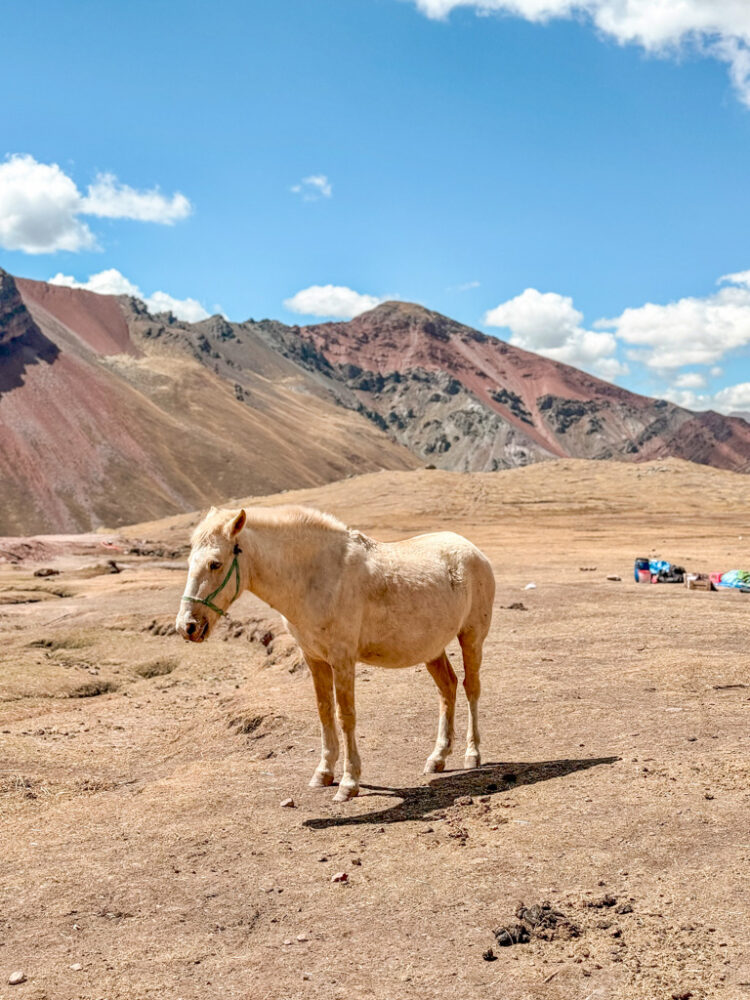

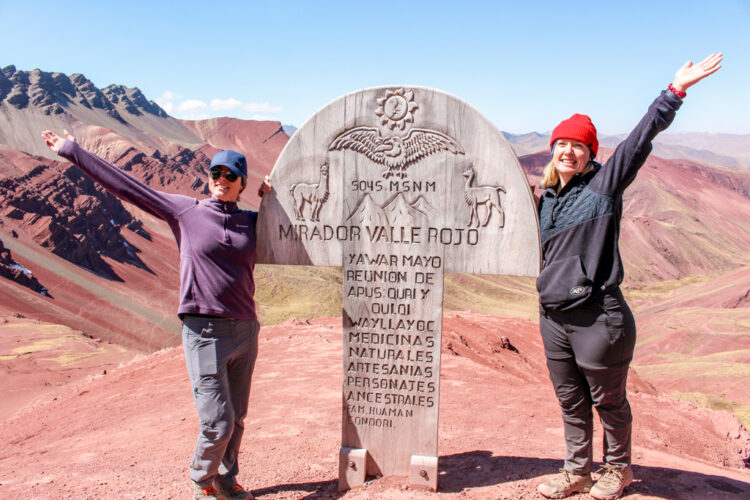
If you want an easier alternative to Vinicunca, check out Palcoyo Rainbow Mountain. It’s a shorter hike with way less crowds, and you actually get to see multiple rainbow-colored peaks instead of just one. But just know this is not the Rainbow Mountain everyone talks about.
Expect to get back to Cusco around 3-4pm, so you have the rest of the afternoon and evening to relax – perfect for a nap (much needed!), a warm shower, and a leisurely dinner.
Plan to sleep in Cusco tonight.
Day 9: Sacred Valley, end in Ollantaytambo
Every Peru itinerary needs some time in the Sacred Valley, including this one of course! Spend the day exploring the area – it’s the lush, fertile heart of the Andes between Cusco and Machu Picchu. And there’s A LOT to see, so I’d recommend picking 2–3 spots depending on your pace (although you can certainly see more if you take a tour).
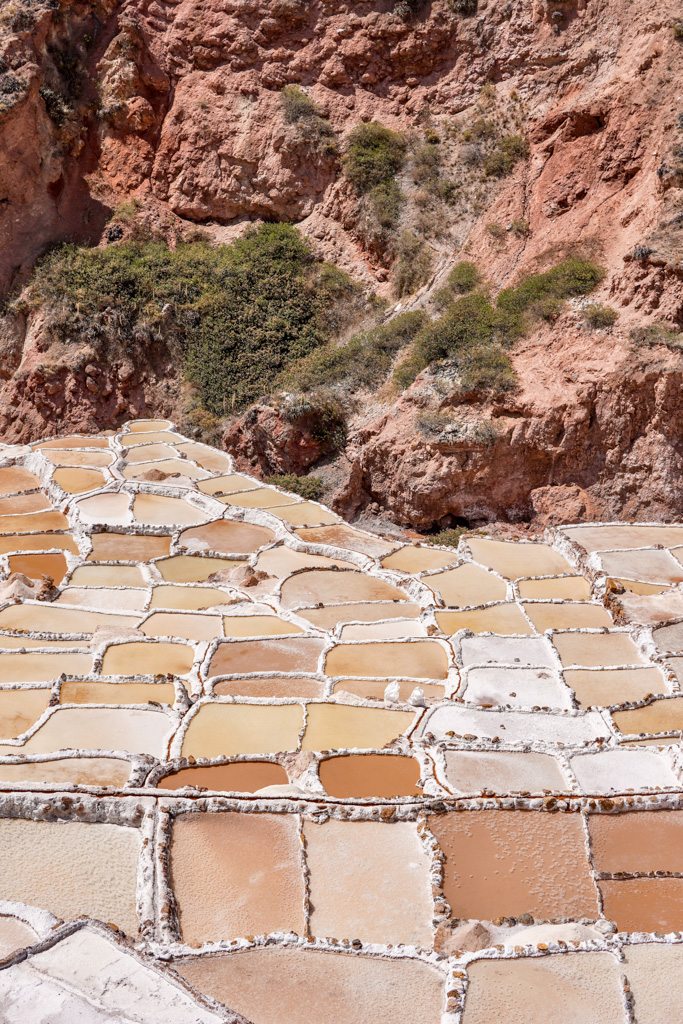


A little about the Sacred Valley: It was called “sacred” by the Incas because of its rich soil, strategic location, and abundance of important ceremonial and agricultural sites. The valley stretches along the Urubamba River and is dotted with traditional villages, Inca ruins, colorful markets, and dramatic mountain scenery – basically, it’s the perfect mix of culture, history, and stunning landscapes.
There’s plenty of day tours from Cusco that hit most of these spots, but I highly recommend ending the day in Ollantaytambo (like this Sacred Valley tour does!). That way, you can easily catch the train to Aguas Calientes (Machu Picchu town) the next morning without having to come back to Cusco.
Here’s a few ideas of how to spend your time in the Sacred Valley:
- Pisac ruins + market: A classic tourist stop with amazing views and a colorful market if you’re into souvenirs and local crafts.
- Moray terraces: I loved this one. The circular terraces look almost futuristic, and it’s fascinating to learn how the Incas used them for agriculture.
- Maras salt mines: Another popular spot. Thousands of salt pools carved into the mountainside make for a surreal photo op. When I went, I actually got to experience the first-ever annual Salt Festival, which was such a unique bonus and oh so fun with lots of traditional dancing.
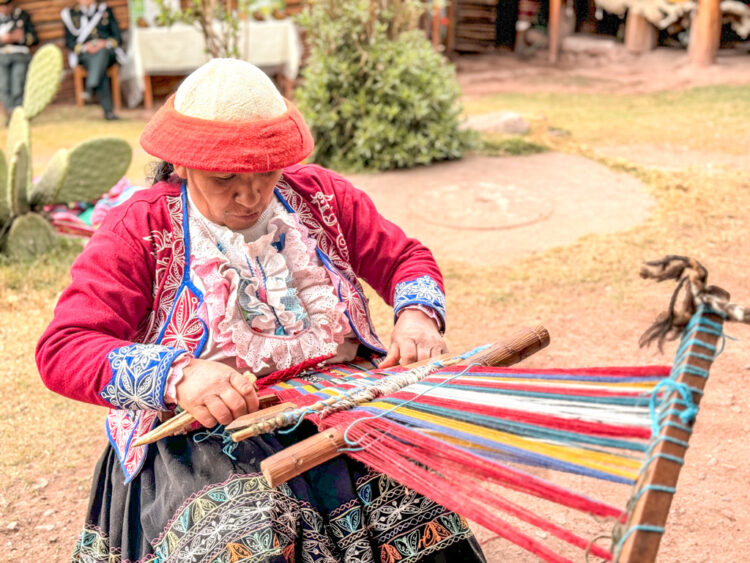
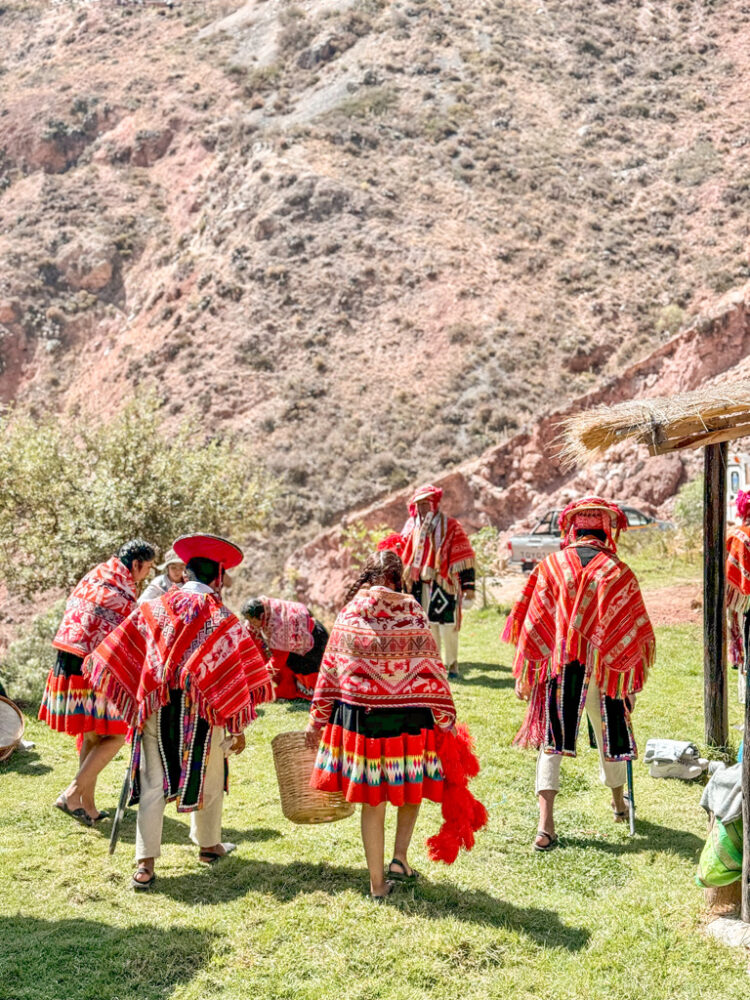
- Chinchero weaving demonstrations: One of my favorite stops. Local artisans show how they dye wool with natural ingredients like plants and insects, then spin and weave it into intricate patterns.
- Women’s weaving co-op: Another amazing spot to support local artisans. We were able to chat with the women, see them working, and buy pieces that directly benefit their community.
- Local pottery-making community: I loved seeing traditional pottery techniques still in use. You can watch them shape, fire, and decorate the pieces, and sometimes even try yourself (which is way harder than it looks, haha).
- Parwa Community Restaurant in Huchuy Qosqo: We LOVED this lunch stop. Not only was all the food locally made with fresh ingredients, but wow the views were amazing!
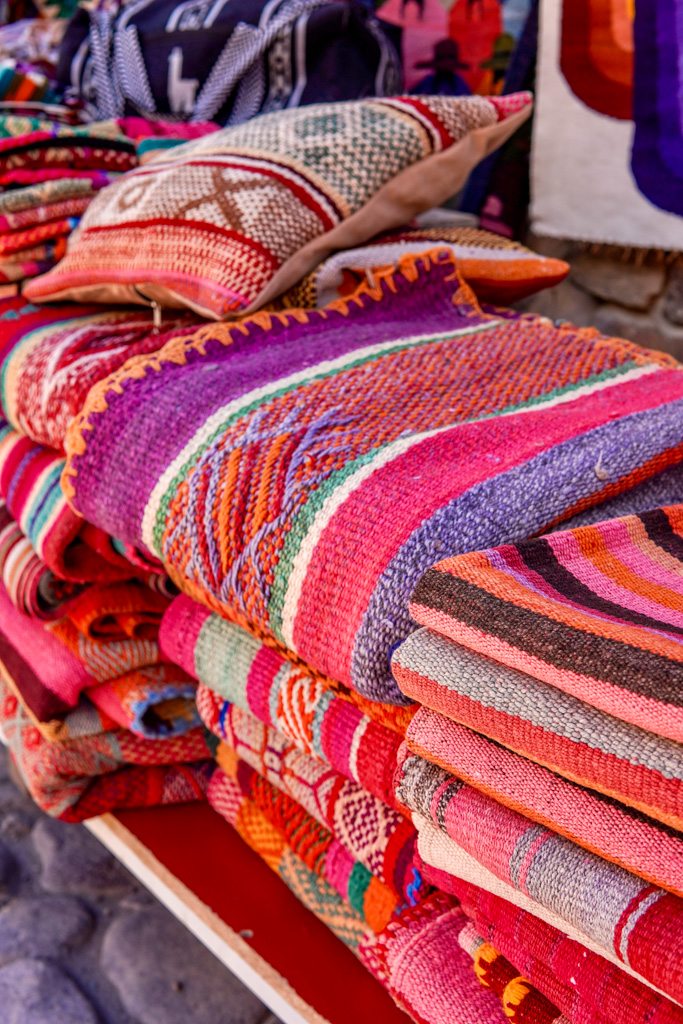
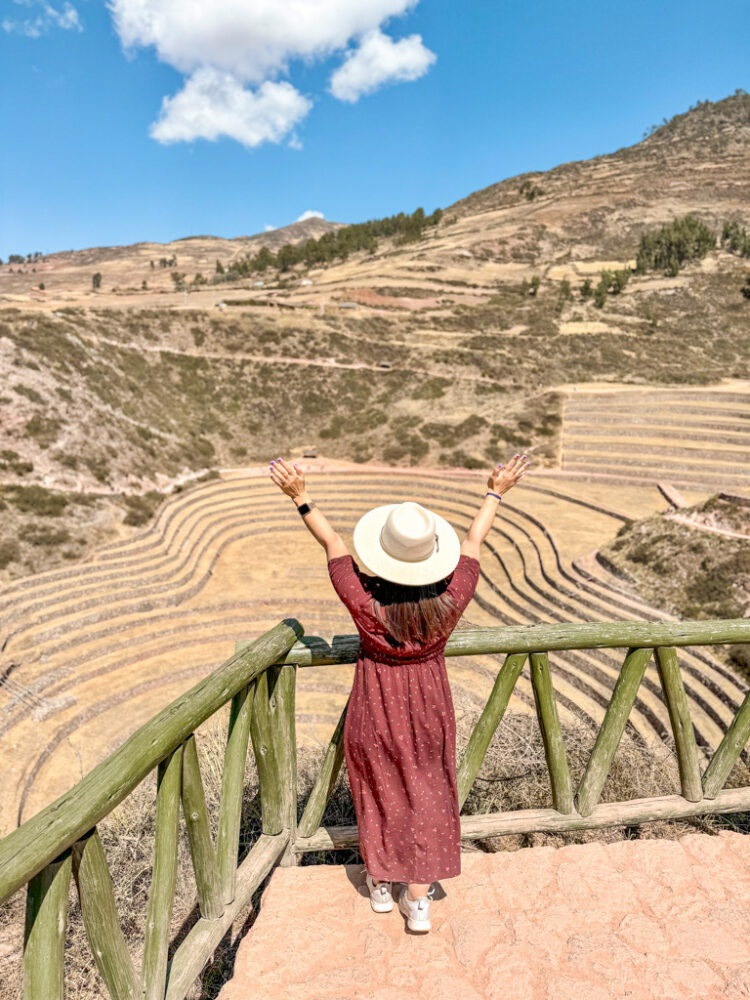
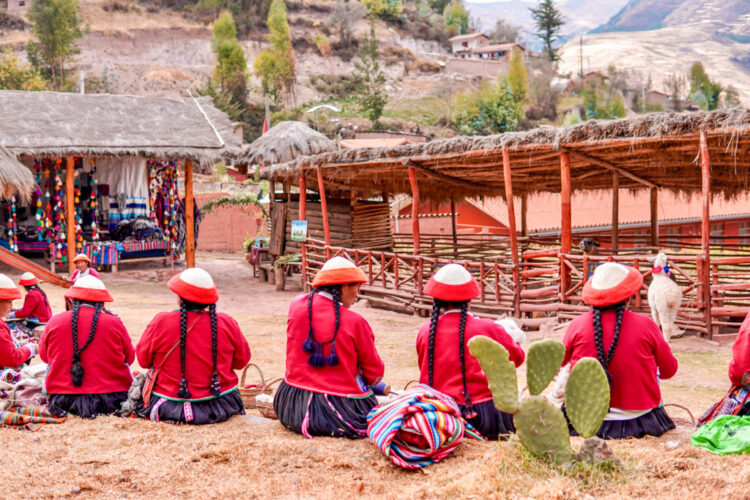
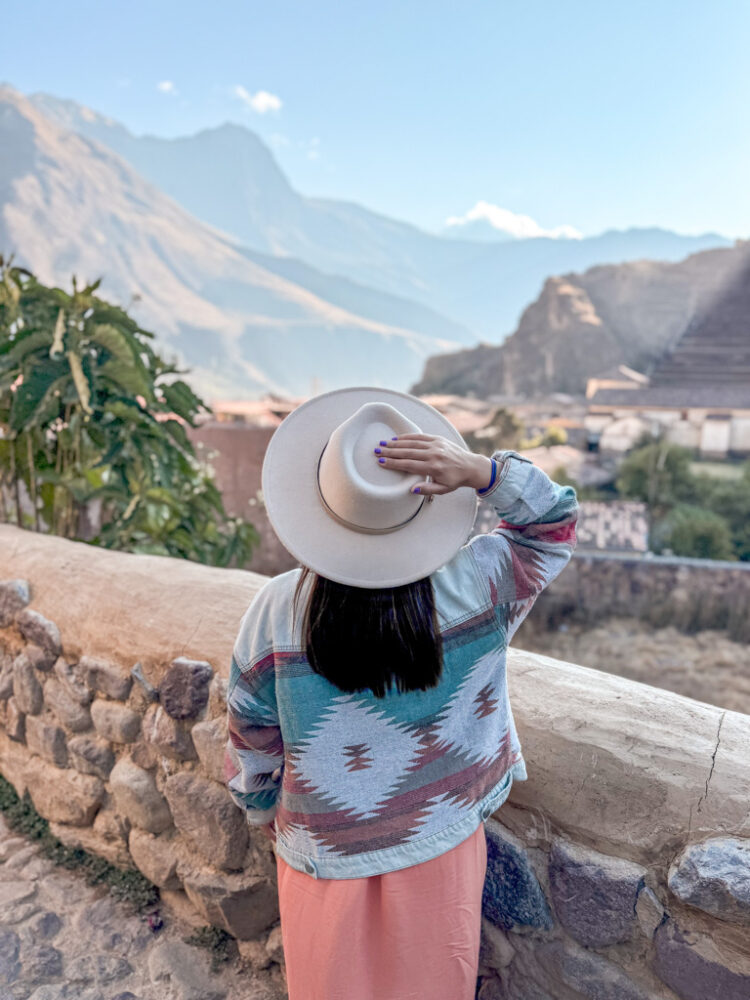
As noted earlier, I highly recommend ending the day in Ollantaytambo, a charming stone town surrounded by mountains. The ruins here are smaller than Machu Picchu, but the town itself has a ton of character and is a perfect spot to wander, grab a drink (Inka Cola anyone?!), and soak in the scenery. Plus, staying here makes your early morning train to Aguas Calientes way easier the next day.
Where to Stay in Ollantaytambo: Hotel Tierra Inka Sacred Valley ($), Hospedaje Turístico – Kantu Inn ($), Kamma Guest House ($), Doña Catta Casa Boutique ($$)
Day 10: morning in Ollantaytambo → train to Aguas Calientes
Start your morning slow and easy in Ollantaytambo (you’ve definitely earned it after all those early wake-ups).
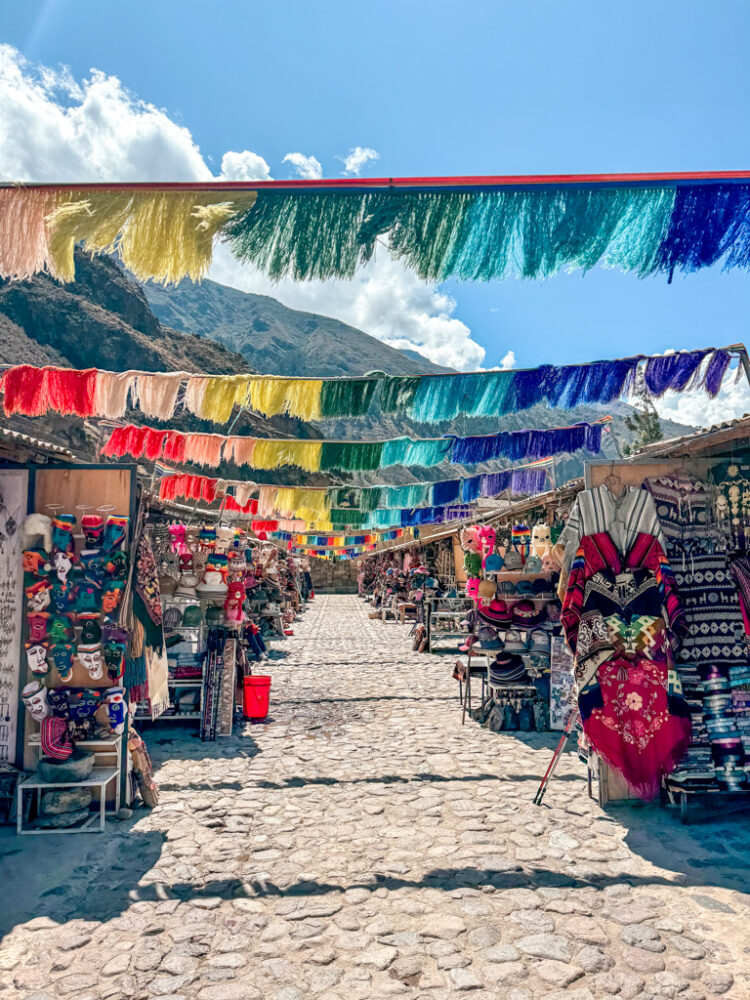
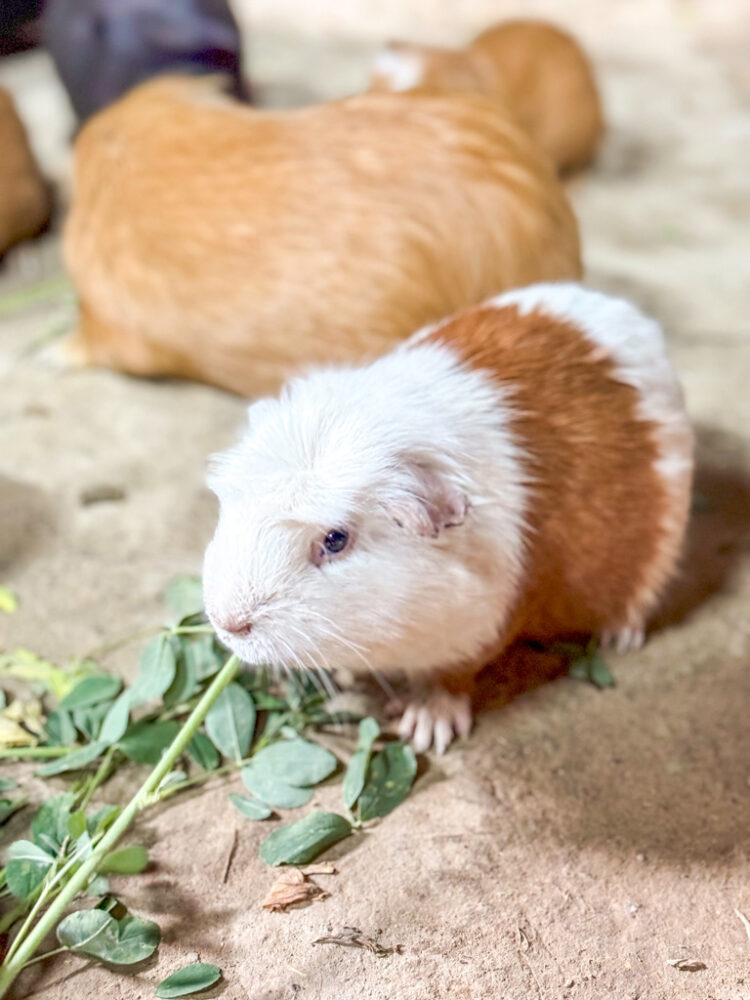
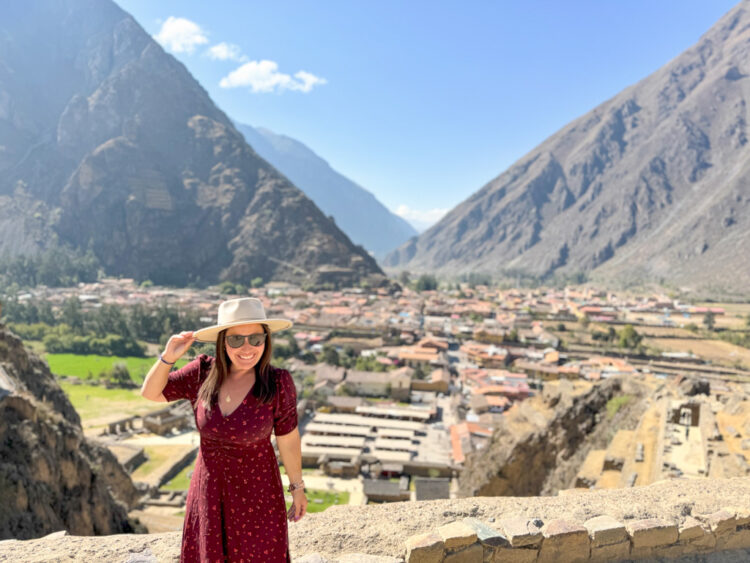
And surprise, surprise, I fell head over heels right away – It’s one of the most picturesque towns in the Sacred Valley, and the kind of place where you just wander. The ruins here are huge, with dramatic terraces carved straight into the mountainside. People often call it a “mini Machu Picchu” because the scale and views are seriously impressive (but it definitely doesn’t take the place of visiting the real Machu Picchu of course).
In a few hours you can do the following:
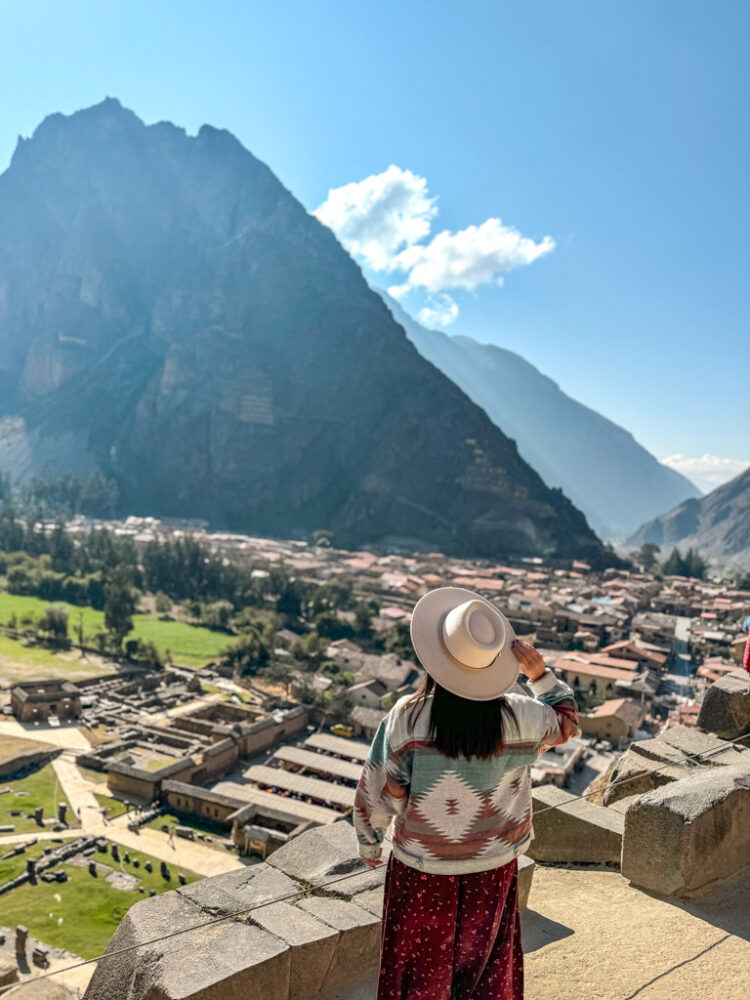
- Ollantaytambo Ruins/Fortress: Climb up the terraces to the Temple of the Sun. Expect steep Inca-built steps, massive monolithic stones, and incredible views over the whole valley. I was in serious awe! The site was both defensive and ceremonial: some terraces helped control erosion, while others gave Inca warriors a serious strategic advantage. It’s a bit of a leg workout, but I promise the views at the top make it 100% worth it.
- Local market: Swing by the small local market right outside the ruins. You’ll find textiles, handmade souvenirs, and snacks and coffee nearby. I had so much fun with photography here – everything was extra colorful! I bought a beautiful blanket with alpaca wool (and I’m actually under it right now as I write this!).
- Wander the town: This town is just perfect for wandering! Ollantaytambo still follows its original Inca layout, with narrow cobblestone streets, stone houses built on ancient foundations, little courtyards, and water channels running through the alleys. It’s one of the few places where you can really feel how an Inca town was designed. And there’s views everywhere!
Afternoon: Train to Aguas Calientes
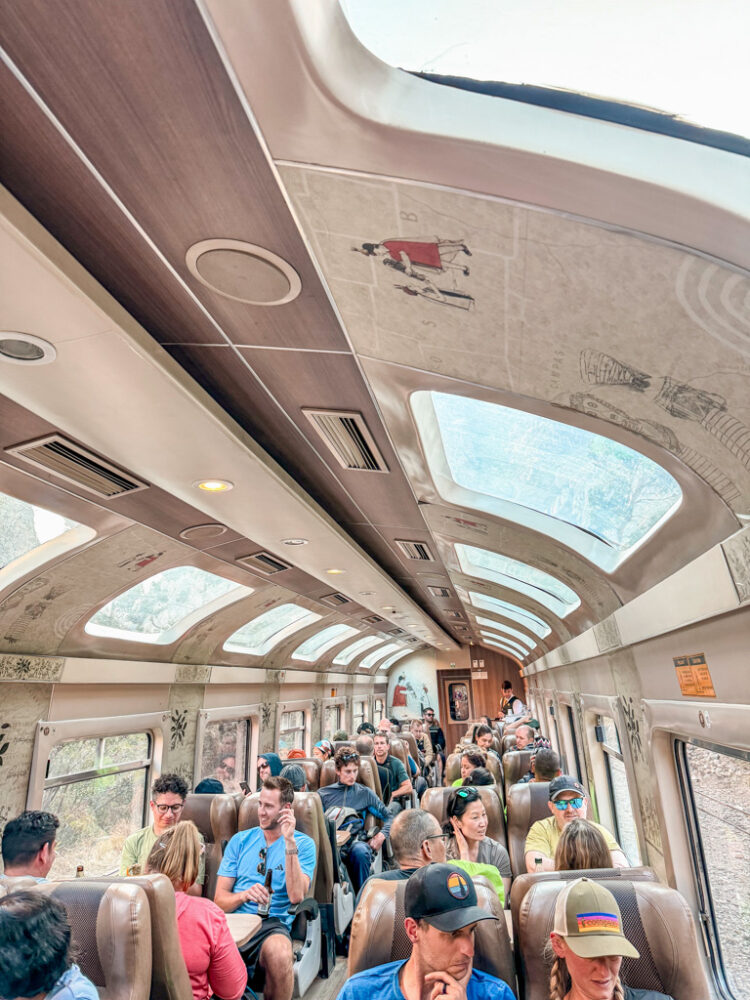
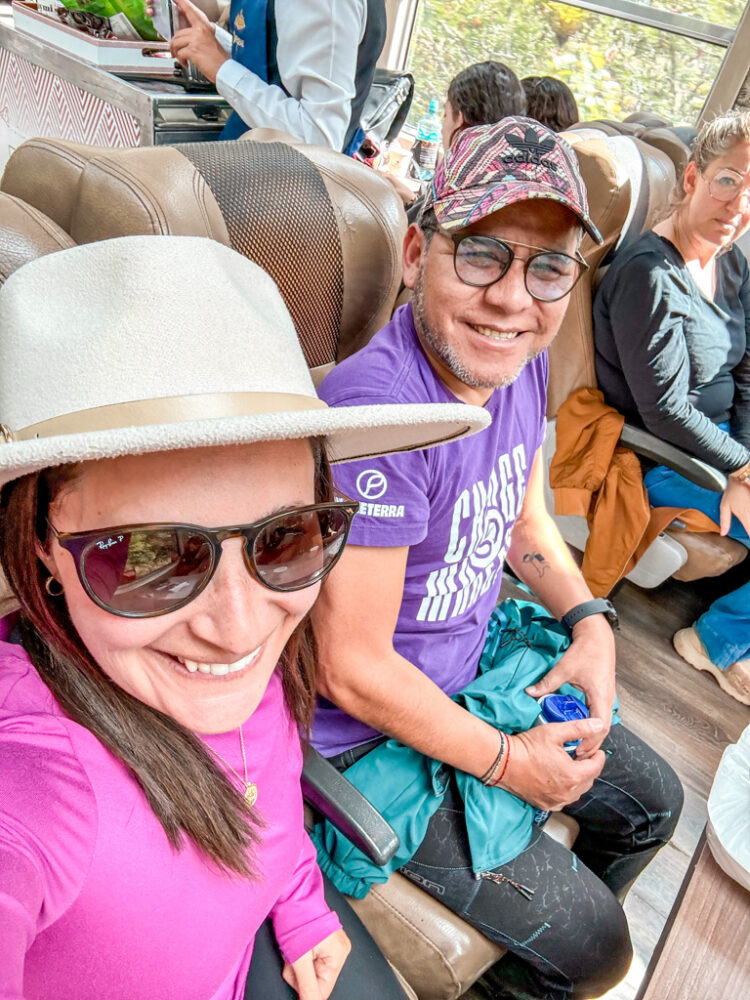
When you’re ready, head to the train station in Ollantaytambo and hop on your train to Aguas Calientes (Machu Picchu town). Yes, we’re getting closer to the main event in Peru – Machu Picchu (that’s tomorrow morning!).
Here’s the breakdown of how that works, plus your options – and yeah, there’s quite a few so you’ll wanna make sure you’re at the right place!
Train Companies and Cost
There’s two main train companies that run the route from Ollantaytambo to Aguas Calientes (also called Machu Picchu Pueblo): PeruRail and Inca Rail.
- PeruRail operates frequent trains on this route. Their Expedition service is the most budget-friendly and popular with travelers. If you want something a little more scenic or comfortable, they also offer Vistadome, and the upgraded Vistadome Observatory, which features larger panoramic windows and an observation/bar car for taking in the views along the way.
- Inca Rail is the other main option, with trains departing roughly every couple of hours. Their Voyager class is the more affordable choice, while the 360° train offers larger windows and more panoramic views of the valley. For a more premium experience, they also run a First Class service with upgraded seating and food.
One thing you might hear about is the Belmond Hiram Bingham, an ultra-luxury train experience. However, it typically runs the Cusco → Aguas Calientes route rather than the shorter Ollantaytambo → Aguas Calientes leg, so it’s usually part of higher-end travel packages.
Train prices vary quite a bit depending on the service level. Based on current timetables, one-way tickets from Ollantaytambo to Aguas Calientes can range from about $30 for the most basic seats up to $600+ for luxury experiences.
In general:
- PeruRail: Expedition (budget) → Vistadome (mid-tier) → Vistadome Observatory / premium services (higher-end)
- Inca Rail: Voyager (budget) → 360° (mid-premium scenic option) → First Class (luxury).
- Most travelers end up somewhere in the $60–$150 range for a standard scenic train.
Duration & Practical Tips
The train ride from Ollantaytambo to Aguas Calientes takes about 1.5 hours and follows the Urubamba River through a narrow canyon, with mountains rising on both sides – so yes, it’s a very scenic trip. I will say after a while the scenery looked the same to me though, haha, kinda like what happened on our scenic train ride in Norway.
A couple of practical tips:
- Book your tickets in advance, especially during high season (May-September), when trains sell out.
- Travel light if possible. Most trains have luggage limits, so you may wanna leave larger bags in Cusco or Ollantaytambo (it’s very common for hotels and storage services to hold luggage until you return).
After You Arrive in Aguas Calientes
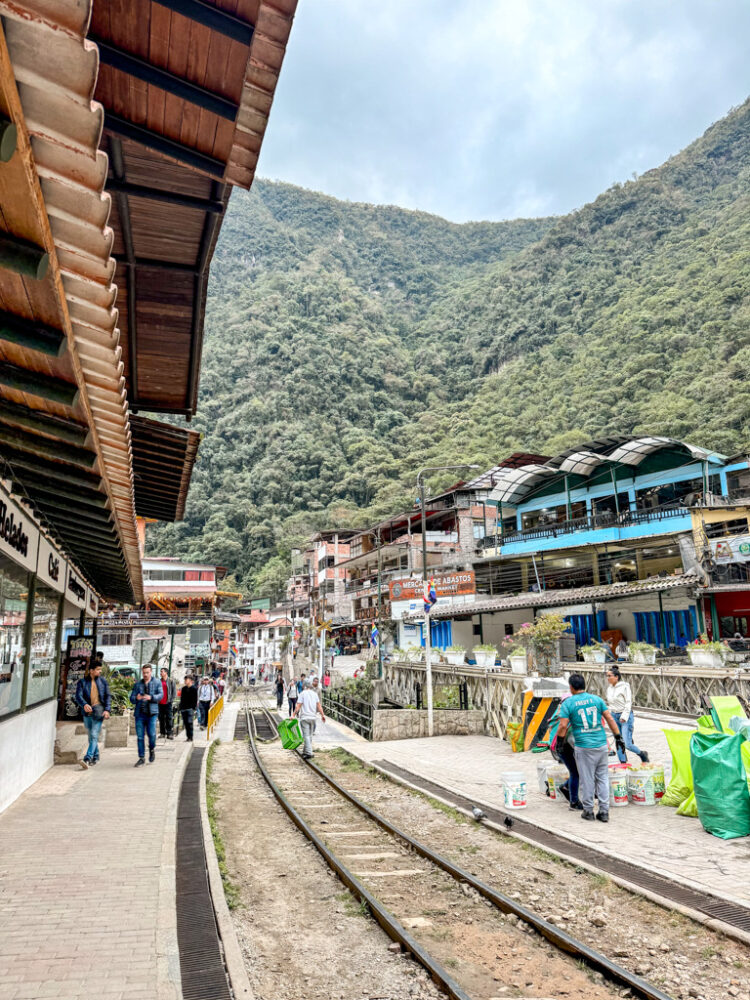
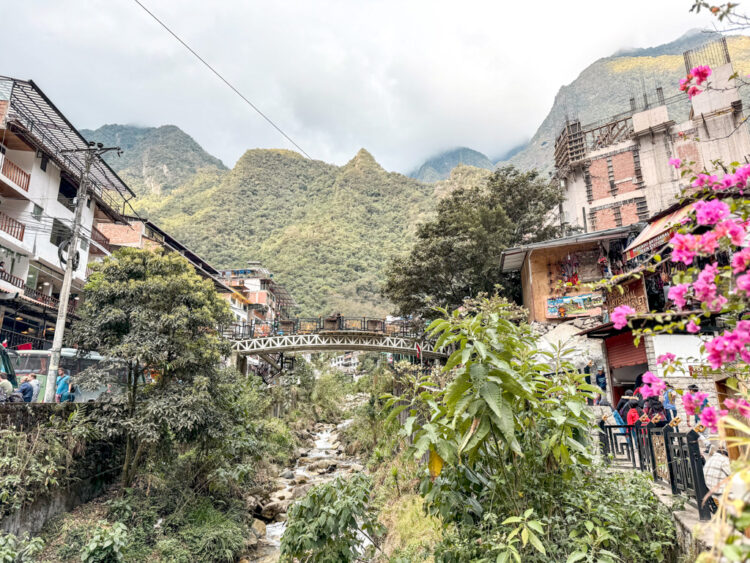
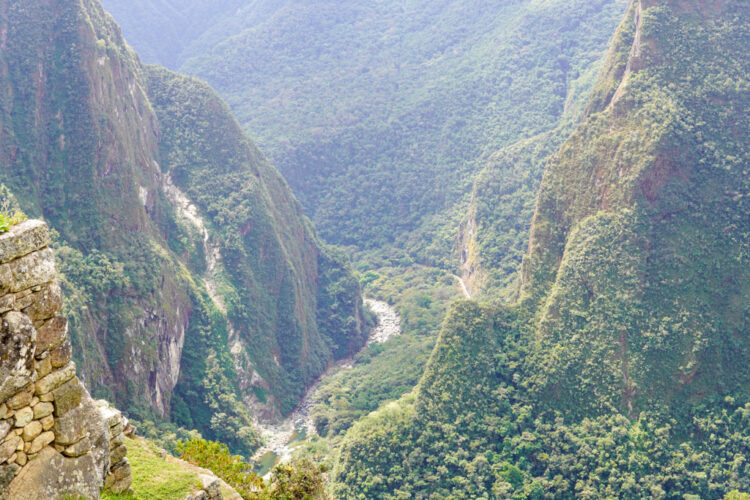
Once you arrive in Aguas Calientes (also called Machu Picchu Pueblo), check into your hotel and then spend some time wandering around town. It’s small, very walkable, and set right between steep green mountains with the river running through it. One thing that really stood out to me was how lush and green everything was – it feels noticeably more jungle-like compared to other parts of the Sacred Valley.
You can stroll along the pedestrian streets, browse the little markets, and maybe grab a drink or a snack somewhere along the river. There’s plenty of small cafés and restaurants, so it’s an easy place to wander without much of a plan and just take it all in.
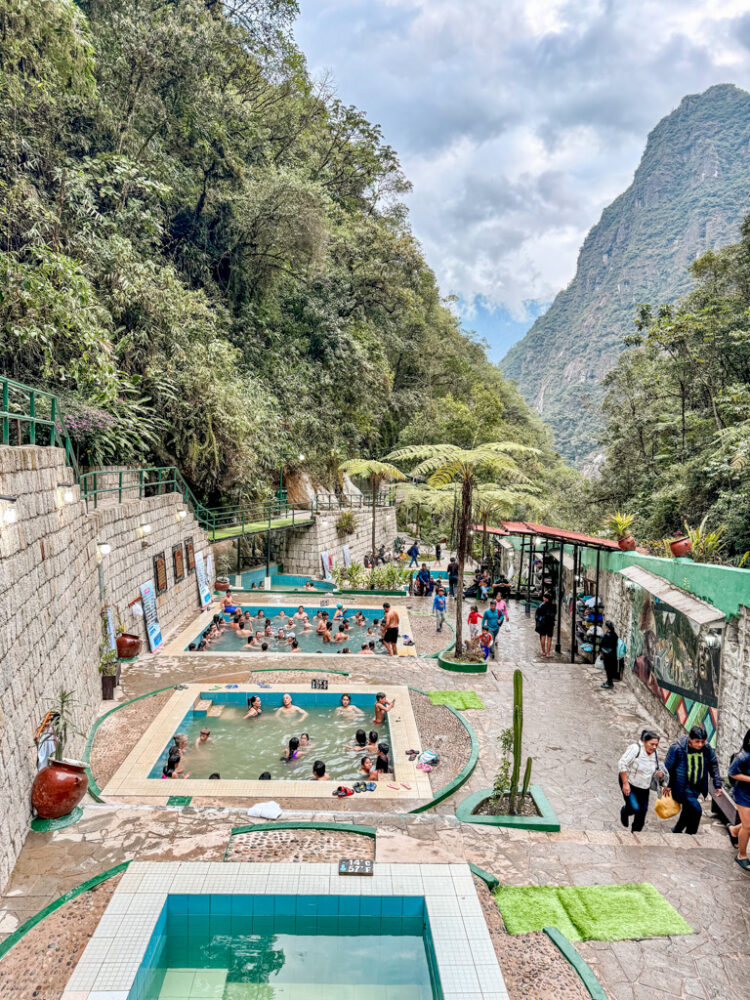
Optional Hot Springs time: If you’re in the mood to relax, you can head up to the Aguas Calientes hot springs. At first glance they can look a little rough around the edges, and I remember thinking they seemed slightly sketchy when I first walked in. But once I saw lots of people already in the pools just relaxing and chatting, I felt a lot more comfortable about it.
They’re definitely not luxury spa vibes (far from it!), but the warm mineral pools are relaxing and can feel really nice after a day of exploring. And they only cost a few bucks.
Day 11: Machu Picchu, head back to Cusco
Wake up early – like, painfully early – because today is Machu Picchu day!

Note: If you want the easiest experience, just book a tour that handles everything for you. You don’t wanna come all this way and realized you messed something up (getting the tickets can be tricky).
This tour includes bus tickets from Aguas Calientes, the actual admission ticket to Machu Picchu, and even a guide. Considering what it comes with, it’s really good value. If I wasn’t on a multi-week tour that handled all this for me, this is 1000% what I would have chosen to do.
You can of course buy your ticket yourself (either from a trusted tour operator like GetYourGuide or from the official Peruvian Ministry of Culture’s website), but I promise you’ll want a guide anyways to truly learn about this fascinating place. You’ll need to buy your ticket months in advance because the government has a limit on how many people can visit each day.
Regardless of what you choose, from Aguas Calientes, you’ll catch the shuttle bus up to the entrance of Machu Picchu. Fair warning: there’s usually a long, long line, so be patient and you’ll eventually get on (we lined up at 6:30am or so and waited I think 45 minutes?).
The ride is actually shorter than the line, at about 25 minutes, and it’s a total thrill because the bus literally hugs the side of a cliff the whole way. If you’re a little nervous with heights, maybe don’t look straight down, haha.
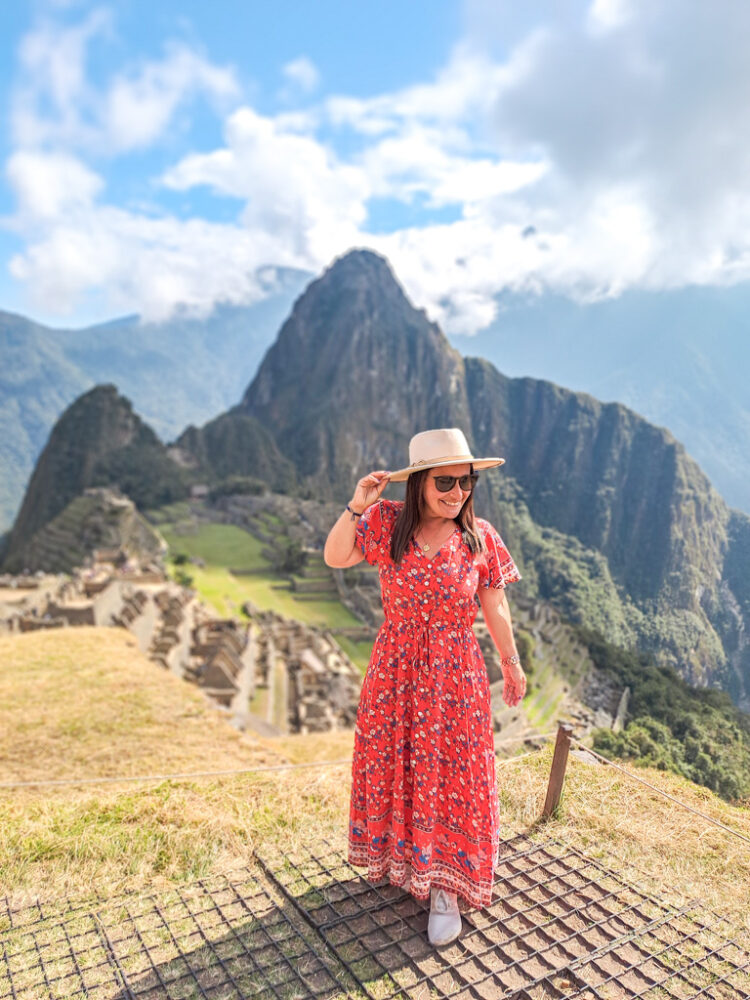
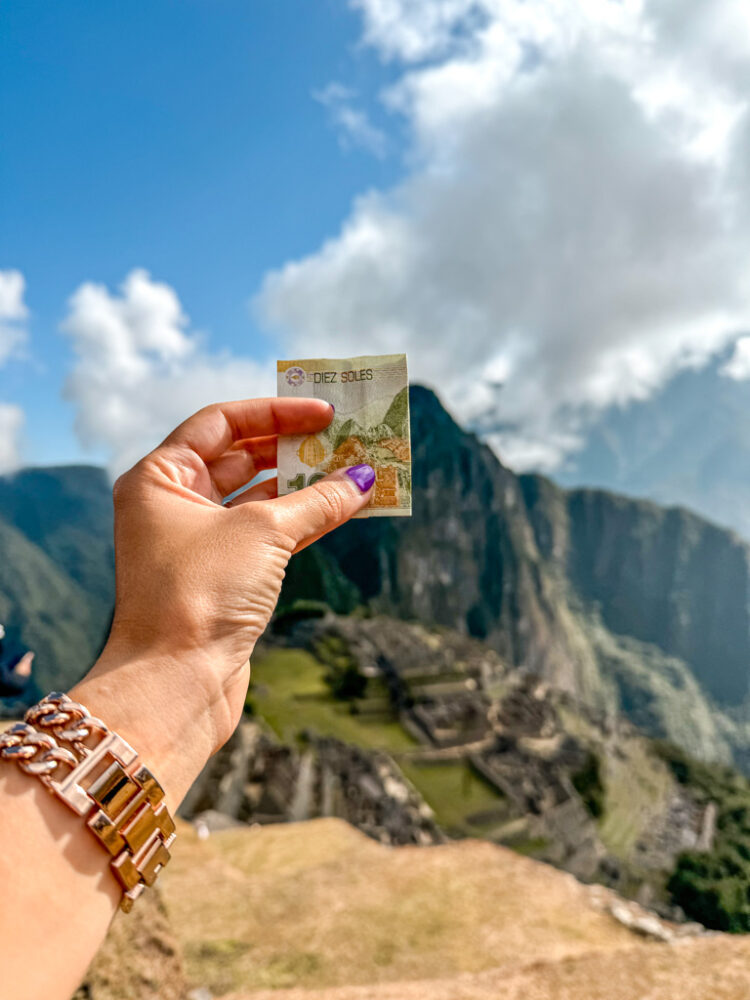

But then you’re there (at Machu Picchu!) and every terrifying second was worth it.
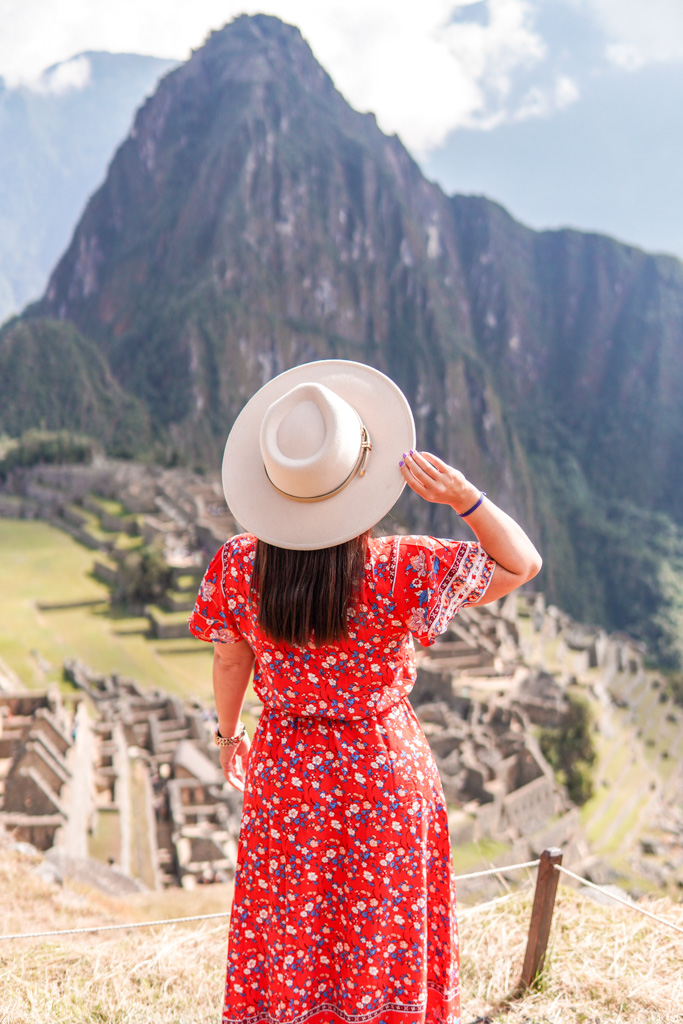
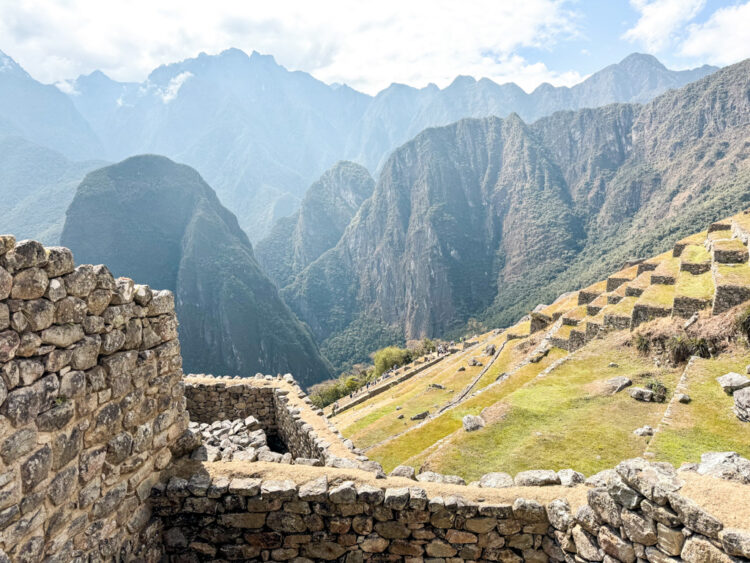
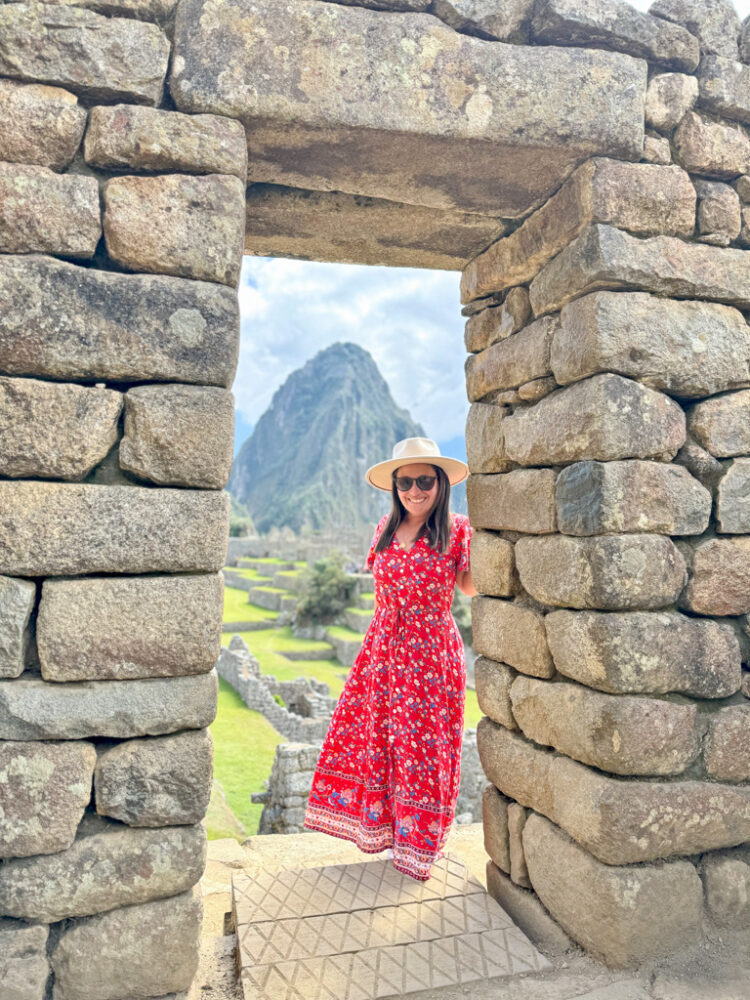
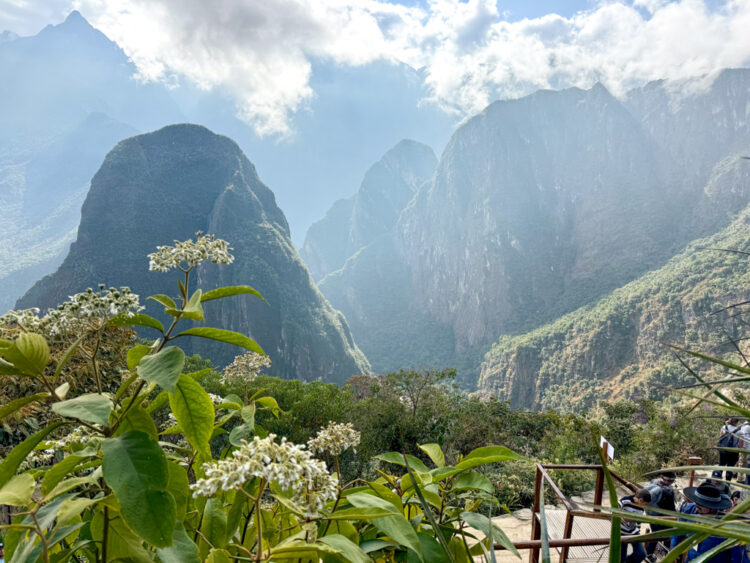
Try and soak it all up without rushing through it; check out the terraces and stone buildings, admire the mountains and jagged peaks, look down below to the Urubamba River, and just revel in the fact that you made it to Machu Picchu!
I spent a few hours wandering through the ruins, climbing terraces, and ducking into stone buildings. Every angle is insane, I can promise you that. I did Circuit 2A, which I’d recommend and which I feel has the best of both worlds – it’s a nice mix of hiking through the ruins and great panoramas from above. I didn’t do Huayna Picchu or Machu Picchu Mountain this time, but I could see why people do – the views from high up must be next-level.
Note that circuits are now one-way; you cannot return to earlier areas so be sure to take your pics before moving on.
Being there really makes you appreciate the Incas: the terraces doubled as farmland and the drainage systems still work after centuries – it’s wild. If you want context, a guide is truly worth it (hey, you came all this way, learn a little!).
Note that clouds and fog are super common, but honestly, even in mist it feels magical. The weather changes fast, so if it’s cloudy, give it a few minutes – it can certainly clear up. May through October is your best bet for clear skies, which is what I got when I went in late-July.
Some people recommend actually visiting Machu Picchu twice – just in case you get super unlucky one of the days. I didn’t have the flexibility to do that, but it’s worth a mention in case you want two chances (which is wise if you’re visiting in the rainy season when it’s definitely harder to see Machu Picchu).
After exploring, take the shuttle back down to Aguas Calientes. Grab a coffee or lunch if you can, then hop on the train and van back to Cusco. The train is about 1.5 hours through lush mountains, and the van finishes the ride into the city. You’ll probably get back in the afternoon or early evening – perfect for a chill dinner and looking back at all your Machu Picchu pictures (I took hundreds!).
Spend the next 3 nights in Cusco.
Days 12-13: Cusco
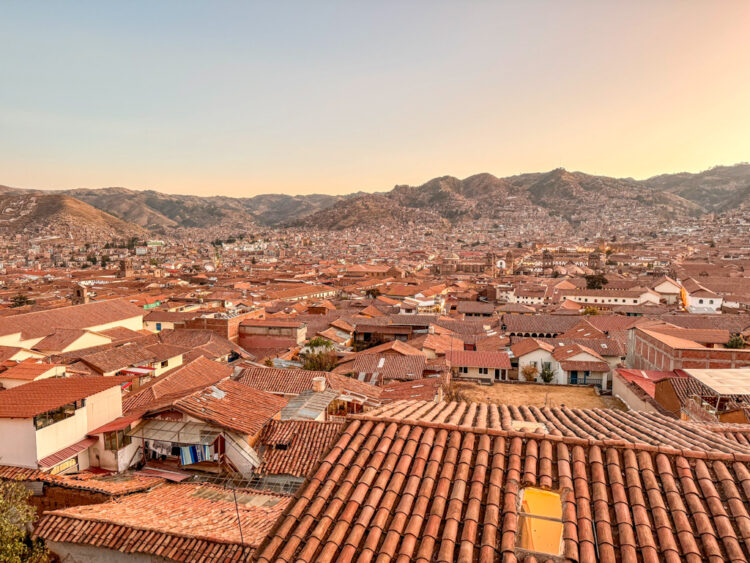
Finally! It’s time to explore Cusco – and honestly, after the whirlwind of the Sacred Valley, Ollantaytambo, and Machu Picchu, you’ll be glad to slow down a bit. I built in two full days here on this Peru itinerary for a reason: you’ll want time to wander, recover, and really soak in the city without feeling rushed. Trust me, I was beyond exhausted by the time I got here!
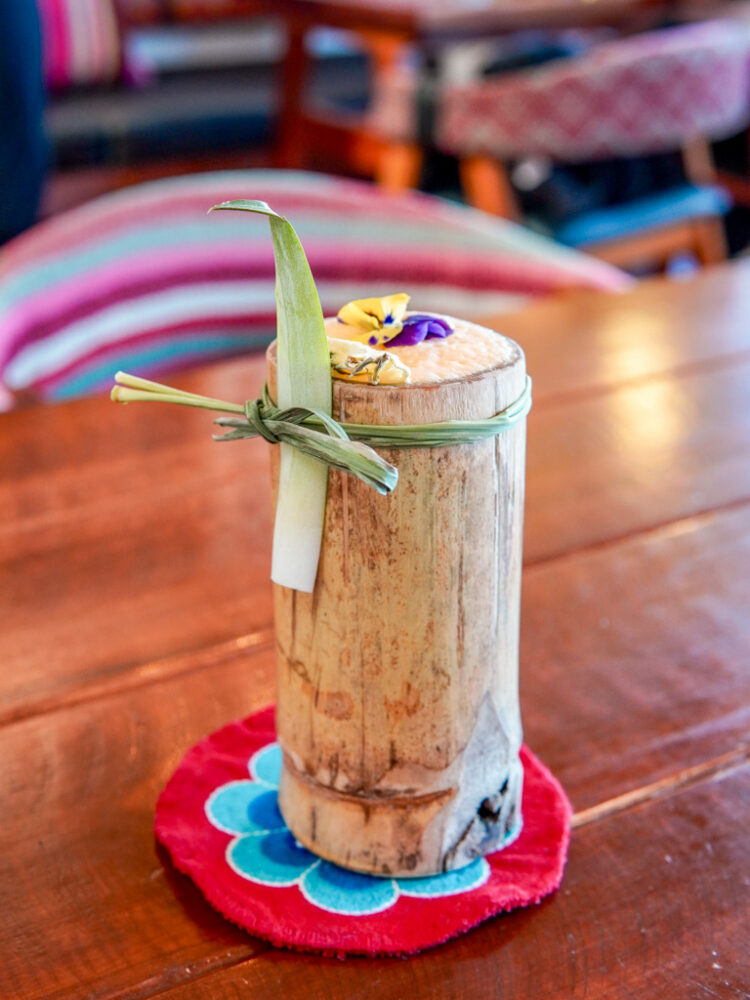
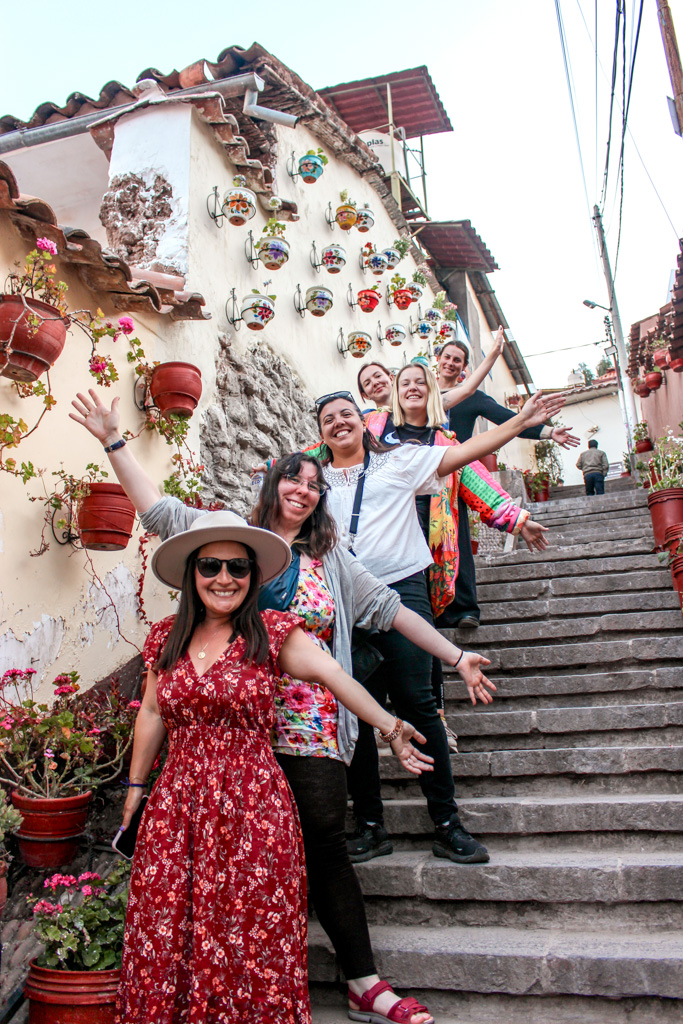
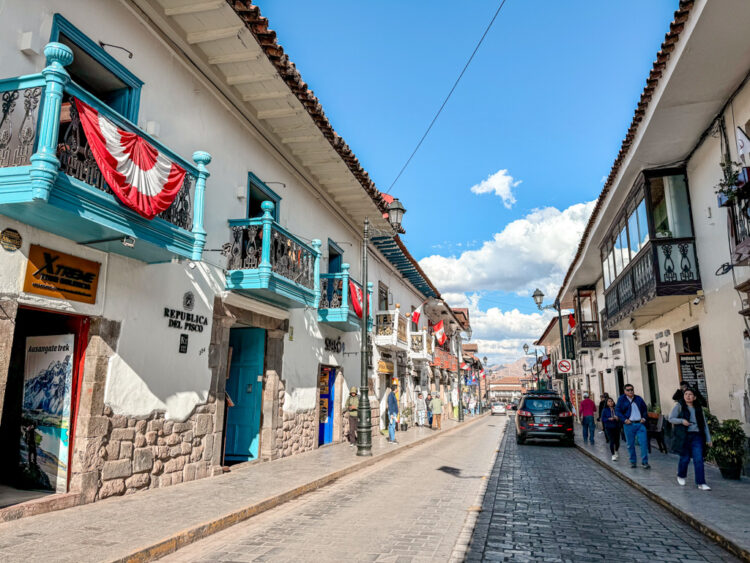
Cusco blends vibrant Incan history with colorful colonial architecture, lively markets, and a food scene that’s impossible to ignore. Every street feels like a little discovery – from artisan shops and alpaca boutiques to hidden cafes and historic plazas – and two days here is the perfect amount of time to soak it all in. And I just loved it! And truly appreciated being in the same bed for more than a night, haha.
I recommend taking a guided tour of the city on your first day (which I did!), then wander around and have a slow day on your second.
Here how I spent my days in Cusco:
- Jack’s Cafe: The best breakfast in Cusco! The dishes are hearty and filling (and HUGE with American portions!), and the fresh juice was absolutely amazing – I always love something refreshing for breakfast!
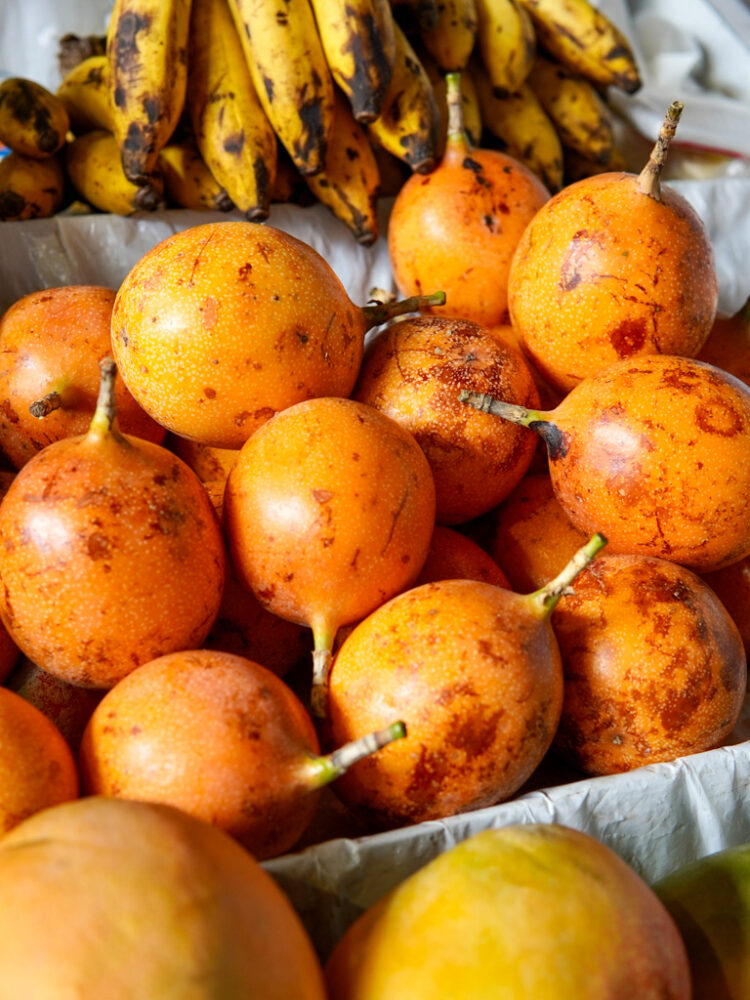
- San Pedro Market: This bustling covered market isn’t just for tourists – locals shop here too, so you know it’s legit. Expect fresh fruits (and fruit juice), breads, cheeses, street food stalls, handmade crafts, and souvenirs. I spent a while wandering, practicing my espanol, sampling treats, and just taking in all the colors and smells.
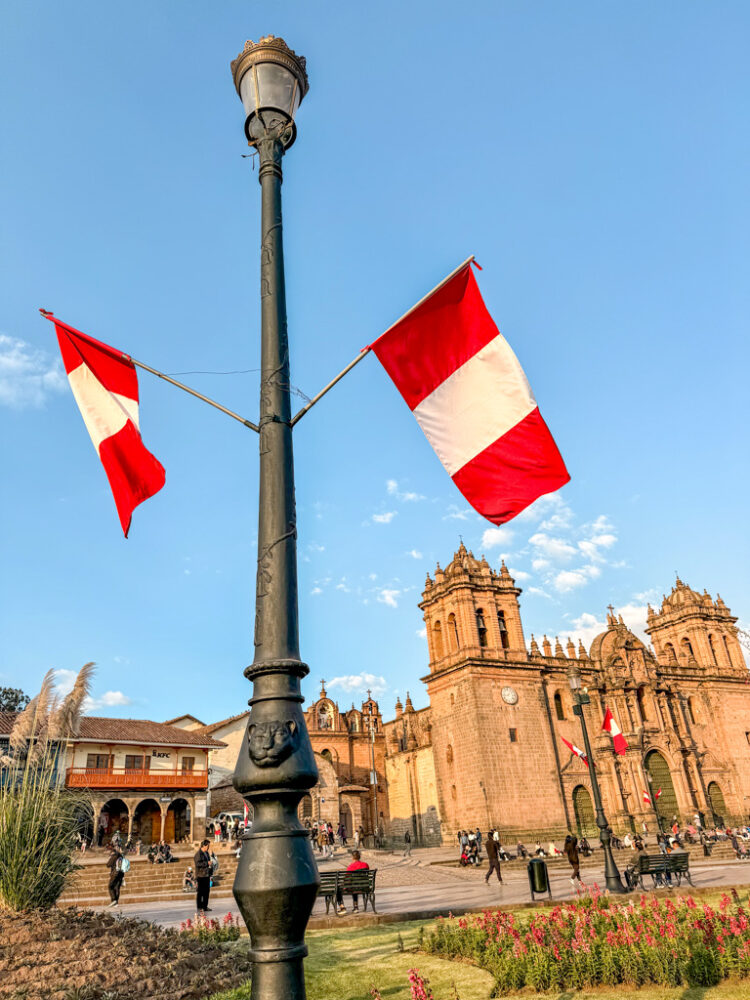
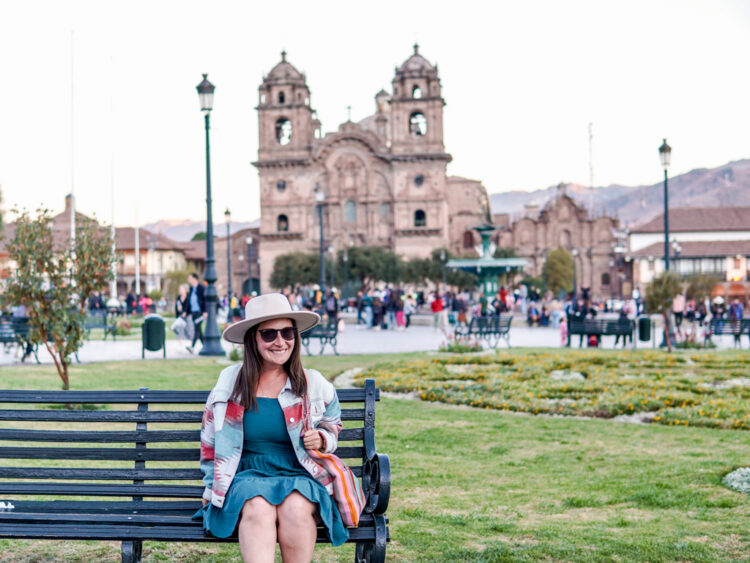
- Plaza de Armas & Cusco Cathedral: I kept coming back to Plaza de Armas, the historic heart of Cusco. I mean, you’ll probably pass by it a bunch of times as it’s right in the middle of the city! The square is always buzzing with energy, surrounded by beautiful colonial buildings, restaurants, and street performers. The Cathedral is just as impressive inside as out, filled with ornate details and history.
- Qorikancha (Temple of the Sun): One of my favorite stops in Cusco. The Inca stonework here is incredibly precise – the stones fit together so perfectly it almost looks unreal. I loved walking around the terraces and taking in the panoramic views over the city while appreciating the ingenuity of the Inca builders.
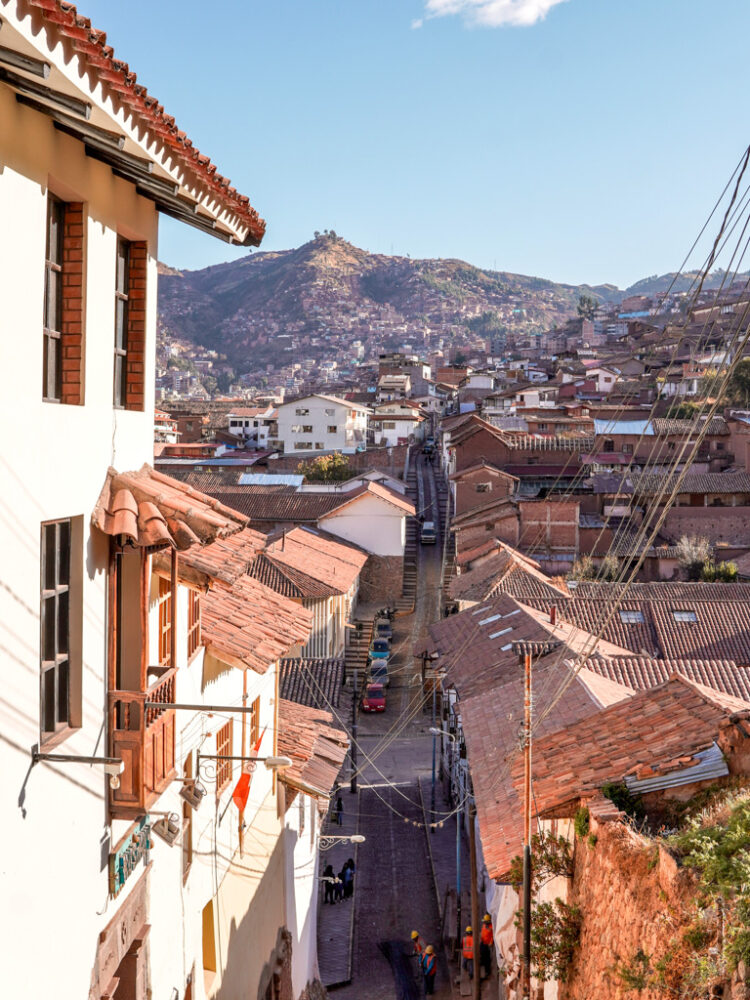
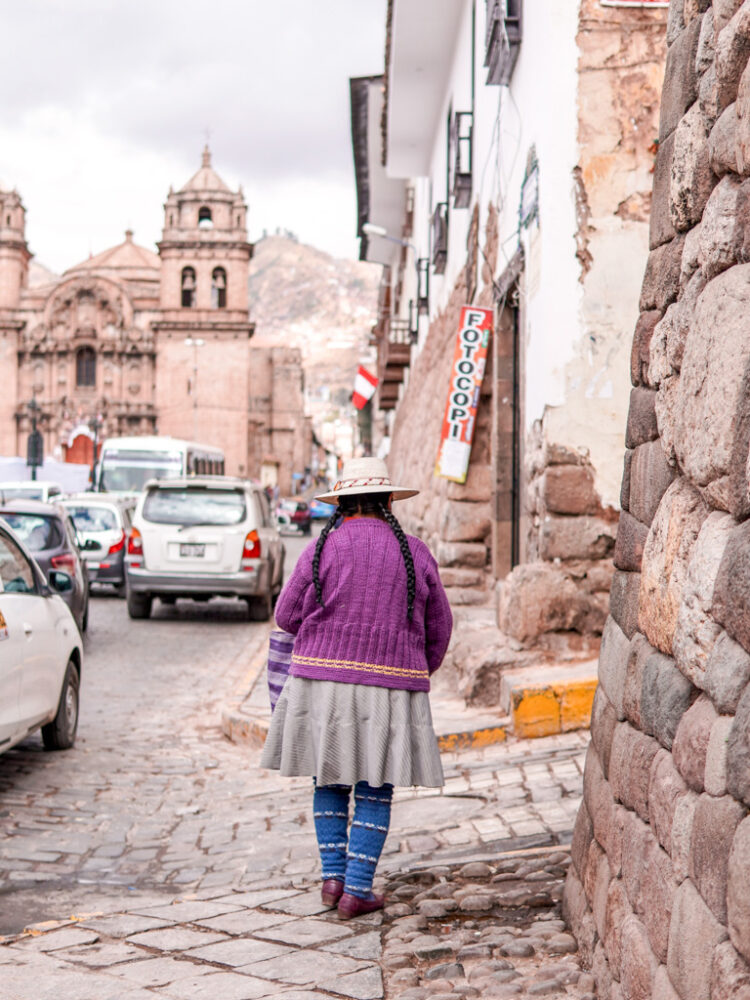
- 12-Angled Stone: I stopped by this famous stone on Hatun Rumiyoc Street, just a short walk from Plaza de Armas. It’s one of those quick stops that’s actually really cool when you see it in person. Each of the 12 angles was carved to fit perfectly with the surrounding stones – no mortar needed. I definitely joined everyone else in snapping a photo and giving it a quick touch.
- San Blas Neighborhood: This neighborhood completely stole my heart. San Blas has such an artsy, laid-back vibe, with cobblestone streets, colorful flower pots lining the steps, and so many little artisan shops and galleries. I loved wandering around and popping into tiny cafés. The Sapantiana Aqueduct is right here, although it was a little underwhelming in my opinion. It definitely feels like Cusco’s little hippie neighborhood.
- Sacsayhuamán: Yes, it’s pronounced exactly as it sounds, haha. I didn’t have time to visit unfortunately, but if you can, definitely go! Sacsayhuamán is a massive Inca fortress just outside the city, and the views of Cusco below are incredible. It’s wild to think about how the Incas moved stones this massive without modern tools.
- Mirador desde el Cristo Blanco: I made the quick trip up here for the views, and it’s totally worth it (although I got cloudy weather). Whether you hike or take a short ride up, the overlook gives you sweeping views of Cusco with the mountains all around. It’s a great spot for photos and getting a feel for the layout of the city.
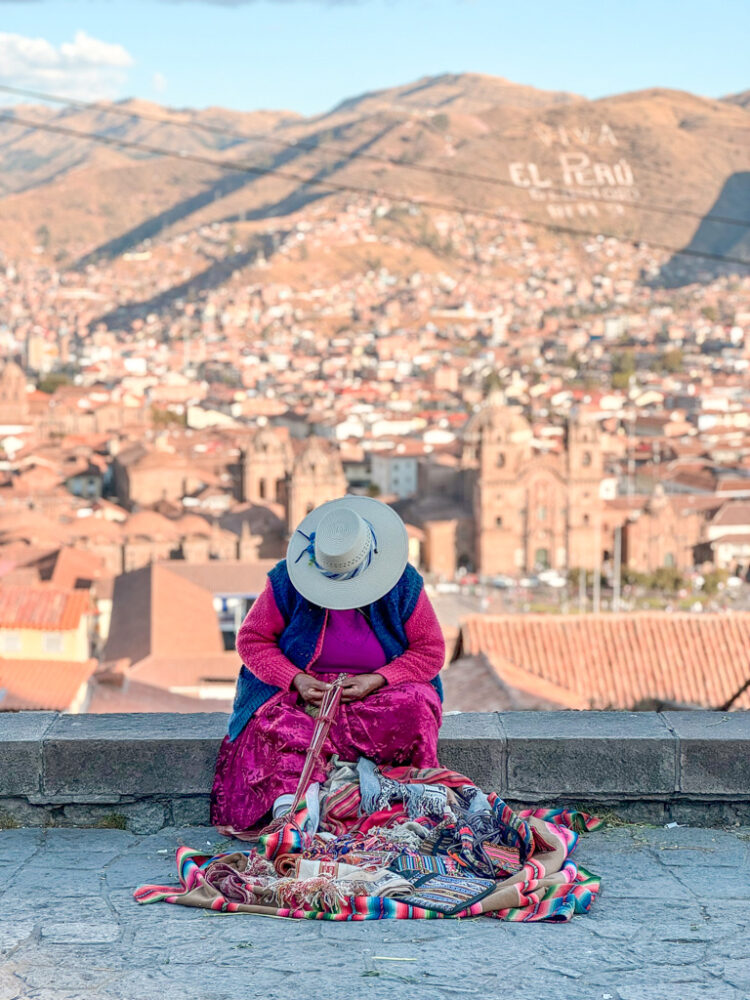
- Mirador de San Cristóbal: This ended up being my favorite viewpoint in Cusco (and I came twice!). Yes, the climb up involves quite a few steps, but the view at the top is unreal. I timed it for sunset and it was magical watching the city lights start to glow while the Andes stretched out behind it.
- Limbus Restobar: I stopped here for a drink one evening and it turned out to be another great sunset spot. Sipping a cocktail while looking out over Cusco and the surrounding mountains was such a vibe.
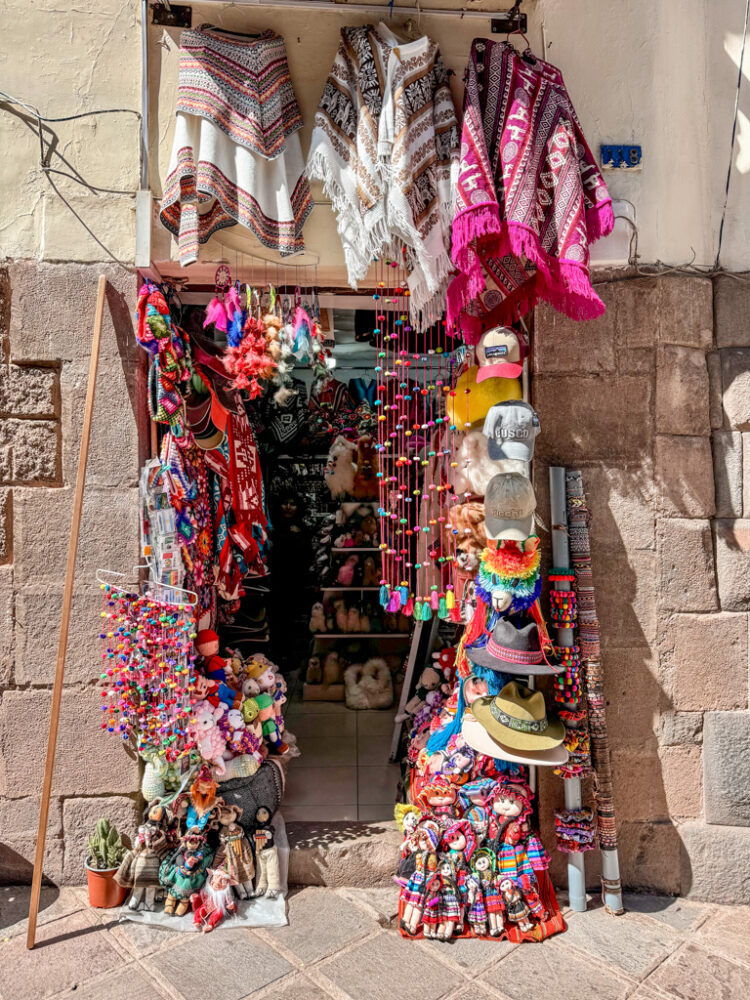
- Alpaca Shops: You’ll see alpaca shops all over the city selling scarves, sweaters, blankets, and hats. Even if you’re not planning to buy anything, I still loved popping into a few just to feel how insanely soft the alpaca wool is.
- Morena Peruvian Kitchen / Nuna Raymi: I had some really great lunches in Cusco, and these two spots stood out. Both serve creative, super flavorful takes on traditional Peruvian dishes and were perfect for a midday refuel between exploring.
- Museums (optional): If you want a slower afternoon or a break from walking, Cusco has some great museums. I considered visiting the Museum of Pre-Columbian Art, which is known for its beautiful collection and thoughtful exhibits.
- Spa/Massage: After the early mornings, altitude, hikes, and lots of walking, I treated myself to a massage at Tao Yin Massage, and honestly, it was exactly what I needed.
Day 14: fly to Lima in AM, day in Lima
Fly back to Lima, spend your last day eating (seriously, eat everything you didn’t get to on Day 1), walk the Malecón one more time, and get ready to head home.
Extra Time? Head to the Amazon!
Psst – have a few extra days to spare? Head on over to the Amazon! You can easily fly right from Cusco (or Lima) to Puerto Maldonado, which is exactly what I did. I then spent 2 nights in the Amazon rainforest, spending my days searching for animals and relaxing in the jungle. I wrote an entire post dedicated to visiting the Peruvian Amazon Jungle, so be sure to check that out!


Just know it’s a COMPLETELY different experience from the rest of Peru. No more high-altitude peaks, but hello scarlet macaws, white caimans, cute capybaras, and monkeys! Yes, monkeys!
Hope this Peru itinerary helps you plan the best possible 2 weeks in Peru! It was by far one of my favorite trips to date.


Leave a Reply